
AI can be useful when building a website, but using an AI builder doesn’t automatically make a site search-friendly. The tools can help with design, layouts, content, and other parts of the build. Wix ADI, Durable, and Hostinger AI are a few examples, while 10Web AI Builder and Elementor AI offer AI features within WordPress.
What matters is what happens with the website after that. A site can look great and still struggle to show up in Google if the content, structure, technical setup, and SEO strategy aren’t right. So, are websites built with AI builders SEO-friendly? Here’s what your business needs to know.
Are Websites Built with AI Builders SEO-friendly?
AI builders can handle some of the technical pieces that help a website perform well in search. Most handle things like mobile responsiveness, page speed, and clean code. Those are important SEO basics, but they’re only part of the equation.
Other details still need to be reviewed. Meta titles, alt text, calls to action, internal links, and contact forms may not be set up the way your business needs them. What you get will depend on the platform, the template, and how the site is built. It’s worth checking those elements rather than assuming they’re already optimized.
Building the website is really just the starting point. A business still has to decide which topics and search terms to target, create content around them, and monitor the site as it grows. AI can make the building process easier, but it doesn’t handle all that ongoing SEO work.
What Makes Websites Built with AI Builders SEO-Friendly by Default
AI builders deserve some credit here. Because they’re built on modern templates and standardized frameworks, they tend to nail the fundamentals without a business owner having to think about any of it.
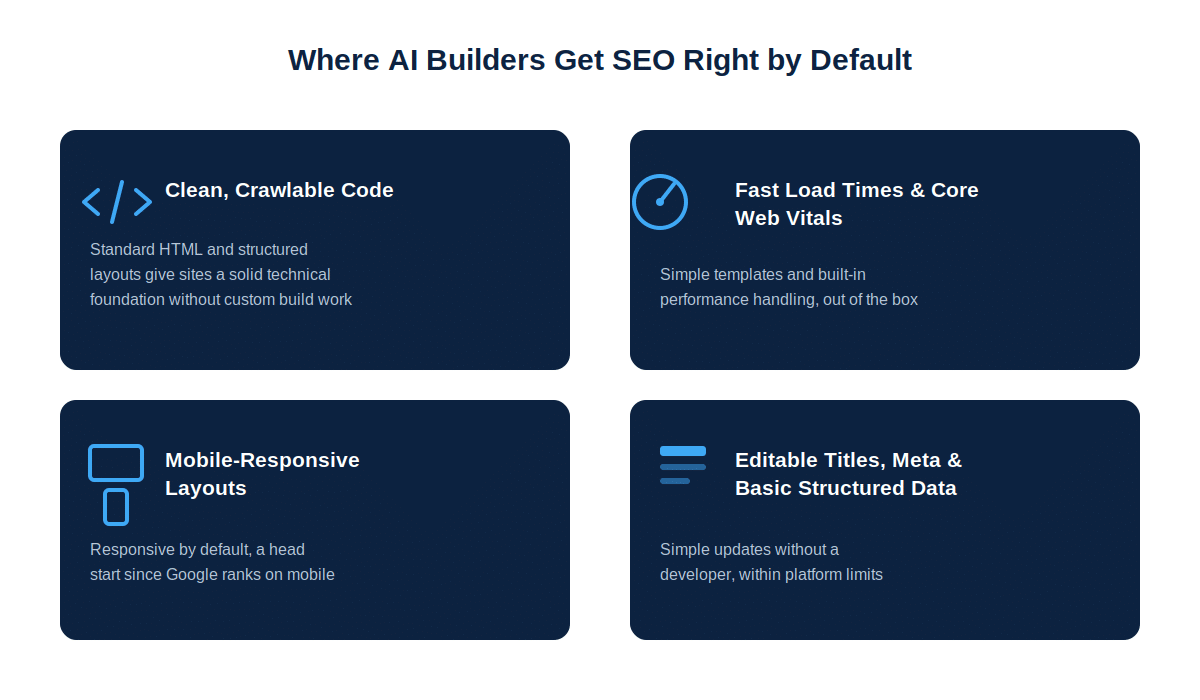
Clean, Crawlable Code
AI website builders generally produce code that search engines can crawl and understand. They use standard HTML and structured page layouts, so a site isn’t starting with the technical problems that can come from poorly built or outdated websites.
That doesn’t make AI-generated code inherently better than developer-written code. A developer can build the same type of structure and has more freedom to customize it. The main benefit of an AI builder is that a business can get a solid technical foundation without building everything from scratch.
Fast Load Times and Core Web Vitals
Many AI website builders start with fairly simple templates, which can help keep pages from getting too large or complicated. The platform also handles some of the technical details that affect performance.
That matters for SEO because Google considers page experience when evaluating websites, including loading speed, responsiveness, and visual stability. That’s where Core Web Vitals come into play.
Still, an AI builder won’t automatically make every website fast. Large images, videos, tracking scripts, and other features can slow a page down. A developer-built site can run just as well, or better, when performance is considered during development.
Mobile-responsive Layouts
Every reputable AI builder outputs a responsive design by default, and since Google indexes and ranks primarily using the mobile version of a site, that’s a meaningful head start.
Experienced developers build responsive sites as standard practice too, so this isn’t a case of AI outperforming skilled development. It’s more that AI makes responsiveness automatic for businesses that would otherwise need to specify it.
Editable Titles, Meta Descriptions, and Basic Structured Data
You can usually change things like the page title and meta description directly in an AI website builder. Some platforms also let you add basic schema markup. For a business owner, that’s helpful because you don’t have to rely on a developer every time one of these fields needs to be updated.
However, limits still apply, depending on the platform. More advanced SEO work may still require code access or a developer’s help.
Where AI-Built Websites Fall Short on SEO
Here’s the part AI builder marketing pages tend to gloss over. A technically sound foundation doesn’t rank on its own, and this is where most AI-built sites hit a ceiling.
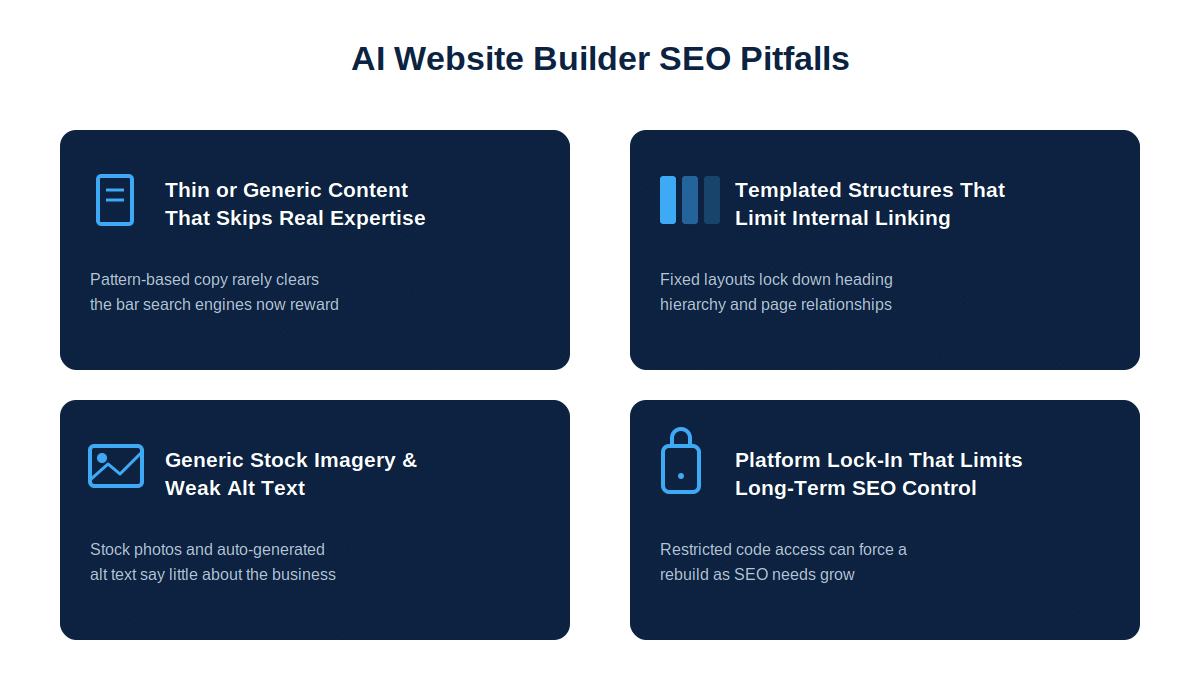
Thin or Generic Content That Doesn’t Reflect Real Expertise
AI-generated copy is built from patterns, not from a business’s experience, customers, or point of view. Search engines increasingly reward content that demonstrates real expertise and firsthand knowledge, and generic AI copy rarely clears that bar on its own. The result is often technically correct pages that say very little a competitor’s site doesn’t already say.
Templated Structures That Limit Customization and Internal Linking
AI builders work from a fixed set of templates, which means the page structure, heading hierarchy, and internal linking options are often locked down. That’s a problem for SEO, since internal linking is one of the more effective (and most overlooked) ways to help search engines understand which pages on a site matter most.
Generic Stock Imagery and Weak Alt Text
Images on an AI-built website may be generic stock photos rather than photos that relate to the business. Alt text can have a similar problem. If the builder generates it automatically, it may describe what’s in the image without providing much useful context.
Stock photos don’t always tell visitors much about the business. Using real photos can help with that. It’s also worth checking the alt text since the AI-generated version may not describe the image very well.
Platform Lock-In That Limits Long-Term SEO Control
The amount of control you have over an AI-built website depends on the platform. Some builders make it difficult to access the code or change things like redirects and advanced schema markup.
That may not matter when the site is new. It can become more noticeable as the business adds pages, changes its URL structure, or needs more involved SEO work. In some cases, moving beyond what the platform allows can mean rebuilding parts of the site or moving to another platform.
How to Make a Website Built with AI Builders SEO-Friendly
None of this means an AI-built site is a lost cause. It means the builder gets a business partway there, and a deliberate strategy covers the rest.
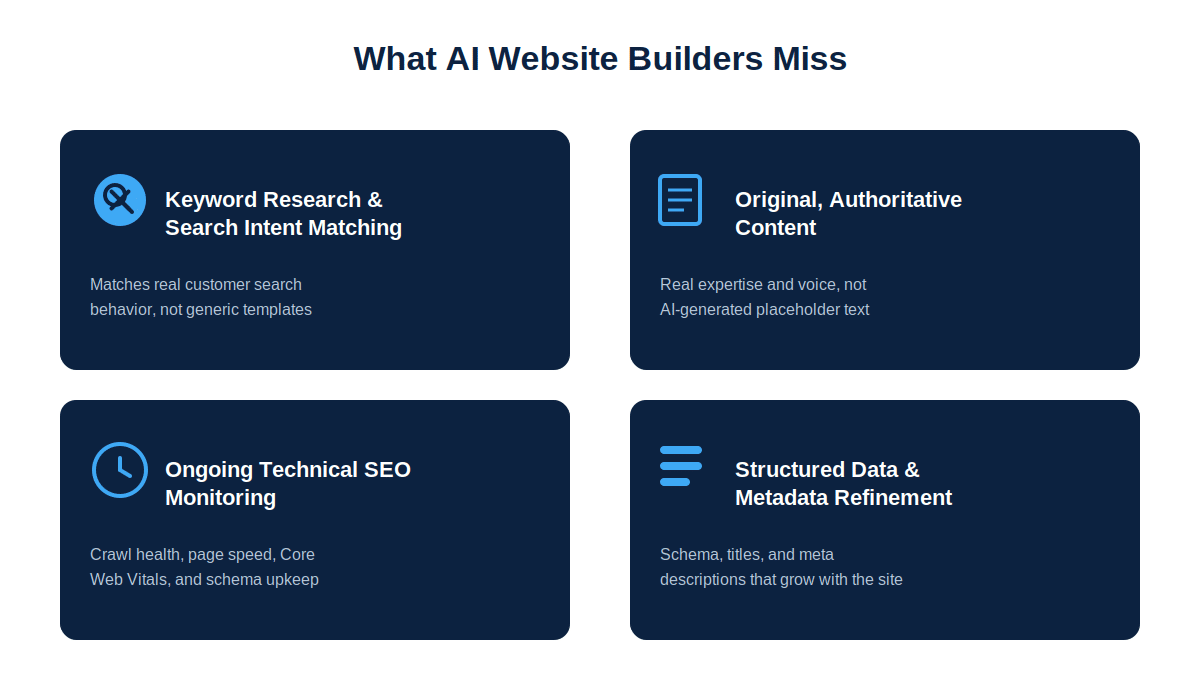
Keyword Research and Search Intent Matching
AI builders don’t know what a business’s customers are actually searching for. Real keyword research, matched to how people phrase their questions and what they’re trying to accomplish, is what turns generic pages into ones built to rank for terms that drive business.
Original, Authoritative Content
Replacing AI-generated placeholder text with content grounded in real expertise, case studies, and a business’s actual voice is the single biggest lever most AI-built sites are missing. This is also where a business starts to build the kind of topical authority that generic templates can’t fake.
Ongoing Technical SEO Monitoring
Launching a site isn’t the end of the technical work. Things can change as you add new pages, forms, plugins, and tracking tools. It’s a good idea to check the site from time to time for crawl problems, page-speed issues, broken links, and other technical issues.
Core Web Vitals and schema markup may need attention as the site changes, too. An AI builder can handle some of the basics, but it won’t necessarily catch every issue that comes up later.
Structured Data and Metadata Refinement
The SEO settings included with an AI builder may cover the basics, but you may need to add more as the site grows. Depending on the site, a business might need additional schema for services, FAQs, reviews, or location information.
The same applies to page titles and meta descriptions. Review these as you add new pages and update them when a page’s focus changes.
Signs Your AI-Built Website Isn’t SEO-Friendly…Yet
A few quick things worth checking if an AI-built site has been live for a while and isn’t gaining traction:
- Page titles and meta descriptions look identical or templated across multiple pages.
- Content reads nearly the same as a competitor’s AI-generated site.
- Google Search Console shows pages that aren’t indexed.
- Load times have crept up since launch.
- There’s no clear internal linking between related pages.
- Images are unedited stock photos with generic or missing alt text.
None of these are dealbreakers on their own, but a site showing several at once strongly signals that the technical foundation needs a closer look.
Is an AI-Built Website SEO-Friendly Enough for Your Business?
AI website builders can give a business a solid starting point, and that’s worth acknowledging rather than dismissing. But the builder is only one part of the process. Whether you’re starting with an AI-generated design or already have an AI-built site, the website still needs strategic SEO work to compete in search. That means researching real keywords, creating content grounded in real expertise, and paying attention to the technical details that can affect search visibility over time.
That’s where Oyova’s team comes in. If you want to use AI to help shape your website, our web design and development team can turn that direction into a functional, professionally built website with SEO in mind from the start. If you already have an AI-built site, our SEO strategists can evaluate it, address potential issues, and identify opportunities to improve its search performance.
Whether you’re starting from an AI-generated concept or looking to improve an existing site, we can help you build a website that’s designed to support your business goals and search visibility. Connect with us today.
FAQs
They can be. Building the site with AI doesn’t prevent it from showing up in Google. What matters more is how the site is built, what it says, and how well it matches what people are searching for. If you’re trying to compete in U.S. search results, you’ll still need good content and ongoing SEO work.
Yes. These platforms usually include SEO features. You can change a page’s title and meta description, and some platforms let you add schema. More advanced changes, including redirects or custom code, may not be available.
Not necessarily. You can improve many AI-built sites in place by replacing generic content, refining metadata, and addressing technical gaps. A full rebuild usually only makes sense if the platform itself is limiting the changes a business needs to make.
Related Posts

What Can Developers Do With AI Web Design?
AI can put together a good-looking website surprisingly fast. But you may not anticipate the more complicated issues...
Read More
DIY AI Website Design: What It Could Cost Your Business
You type in your business name, answer a few prompts, and thirty seconds later you have a website....
Read More
How Businesses Can Improve Answer Engine Optimization (AEO)
Ranking well used to mean earning a top spot among the ten organic listings on a Google results...
Read MoreOur Awards