Ranking well used to mean earning a top spot among the ten organic listings on a Google results page. That’s no longer the case. Type a question into Google today, and you’re just as likely to see an AI Overview answer it before you scroll past the first result. Ask ChatGPT, Perplexity, Copilot, or Gemini the same question, and you’ll get a similar experience: a direct answer, pulled together from sources the AI decided were worth trusting. Instead of handing users a list of links to click through, these tools read the web, summarize it, and decide who gets mentioned.
So what determines whether your business shows up in that answer? Not just your ranking. It comes down to whether an AI system can actually understand your content, decide it’s trustworthy, and feel confident enough to pull it into what it tells the user. That’s the real question behind how businesses can improve Answer Engine Optimization, and it’s quickly turning into a core piece of any digital strategy that wants to hold up over the next few years.
What Is Answer Engine Optimization (AEO)?
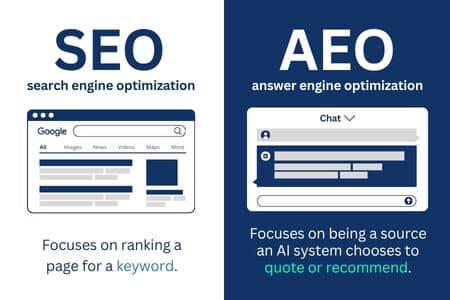
Answer Engine Optimization (AEO) is the practice of structuring and strengthening your website’s content so AI-driven search tools can easily find, interpret, and cite it as part of a generated answer. While traditional SEO focuses on ranking a page for a keyword, AEO focuses on becoming the source an AI system chooses to summarize, quote, or recommend.
The two disciplines overlap heavily. Technical SEO still matters. So does quality content and a healthy backlink profile; none of that goes away. What AEO adds is a structural requirement. A language model needs to be able to pull a direct, accurate answer out of your page, not just find it relevant.
People often bring up generative engine optimization, or GEO, in the same breath. It’s a similar idea, aimed more specifically at generative AI tools rather than the crawlers that power traditional search. For most businesses, the distinction between AEO and GEO isn’t worth agonizing over. Both are really about the same thing. Writing content an AI can understand and trust enough to use.
How AI Search Engines Work
Each major AI search tool works a little differently. However, the underlying goal is similar. To interpret a user’s question and generate a direct, useful answer rather than a list of links.
- Google AI Overviews pull information from top-ranking, well-structured pages and generate a summarized answer at the top of the search results.
- ChatGPT draws on a combination of trained knowledge and, when browsing is enabled, live web content to answer questions in a conversational way.
- Perplexity functions as an answer engine by design, citing sources directly within its generated responses.
- Microsoft Copilot integrates AI-generated answers into Bing search results and Microsoft’s broader product ecosystem.
- Gemini powers Google’s AI-driven search experiences and increasingly influences how content is surfaced across Google’s properties.
Across all of them, the pattern holds. Clear, well-organized, and credible content has a far better chance of being selected and cited.
Why Businesses Should Care About AEO
AI-assisted search isn’t a niche trend. It’s becoming a standard part of how people research products, services, and companies before they ever visit a website.
Consumer Behavior Is Changing.
Instead of typing short keyword phrases and clicking through several results, more users are asking full questions and expecting a complete answer immediately.
The Risk: Zero-click Search.
That shift has created what’s known as zero-click search, where a user gets the information they need directly from the AI-generated answer without visiting any website at all. For businesses, that raises the stakes. If your content isn’t the one being cited, you may lose that opportunity to be seen entirely, regardless of how well you’d otherwise rank.
The Opportunity: Stronger Brand Authority.
There’s an upside to all of this, though. Brand authority carries more weight in an AI-driven landscape than it used to. A business that builds real expertise and puts genuine effort into how its content is structured can earn visibility it might never have gotten through traditional rankings alone. That’s true whether you’re a five-person shop or a company with a full SEO department, which is part of why AEO for businesses of every size has become such an urgent priority.
10 Ways Businesses Can Improve Their Answer Engine Optimization

Figuring out how to improve Answer Engine Optimization (AEO) doesn’t mean throwing out your SEO playbook and starting over. Most of it still applies. What changes is the level of clarity, structure, and trust your content needs to hit. Here’s an Answer Engine Optimization strategy broken into ten practical moves.
1. Create Helpful, Comprehensive Content
AI systems have gotten pretty good at telling the difference between a page that mentions a keyword and a page that actually answers the question behind it. Aim for the second one. Address real customer questions in full, lean into topics your business genuinely knows, and don’t stop halfway through. Google says something similar in its own guidance on creating helpful content: write for people first, and the rankings tend to follow.
Focus on Search Intent, Not Just Keywords
A page can rank for the right keyword and still fail if it doesn’t match what the searcher actually wanted. Before you write anything, figure out the problem someone’s trying to solve or the decision they’re trying to make. Content built around that intent beats content built around a phrase list, in both traditional and AI-driven search.
2. Optimize for Questions
When people are asking questions online, they’re typing in full questions, not just “keywords.” AI tools are built to answer exactly that way. Question-based headings, FAQ sections, and answers that get to the point quickly make it easier for an AI system to lift what it needs. It’s the same structure that tends to win featured snippets in regular search, too.
3. Strengthen E-E-A-T
You’ve probably seen the acronym E-E-A-T floating around:
- Experience,
- Expertise,
- Authoritativeness, and
- Trustworthiness.
It’s become the shorthand for how Google, and increasingly AI tools, judge whether content is worth trusting. In practice, that comes down to a few plain questions a reader (or a model) can answer just by looking at the page, such as:
- Who wrote this?
- Do they actually know the subject?
- Does the information hold up?
Pages that answer those clearly tend to have an edge.
Demonstrate Real Expertise
This is where the specifics matter. Author bios with real credentials, case studies that show what actually happened, testimonials, and original research are all things that separate a page written from genuine experience from one that’s just summarizing the topic from a distance.
4. Build Topic Clusters Instead of Individual Articles
A website full of disconnected articles rarely convinces an AI system that you’re an authority on anything. A topic cluster does a better job.
- One strong pillar page covering the subject broadly,
- A set of supporting articles going deeper on specific pieces, and
- Internal links tying it all together.
This content structure signals depth in a way scattered content never quite manages.
5. Use Structured Data (Schema Markup)
Schema markup tells search engines what a page is about. Depending on the page, that could mean:
- Organization
- LocalBusiness
- FAQ
- Article
- Product
- Service
- Review
- Breadcrumb
Schema.org maintains the vocabulary most search engines rely on, and getting this right is one of the more technical steps on this list, but also one of the highest-value ones.
6. Improve Internal Linking
Internal links on your website tell AI systems how your pages relate to each other. A few habits worth building into your process:
- Link topic clusters together. It’s one of the clearest ways to show AI systems how your content fits into a bigger picture, not just that a page exists on its own.
- Skip generic anchor text. “Click here” tells a reader, or an AI system, nothing. Use text that actually describes what’s on the other end of the link.
- Only link where it’s actually relevant. A link that doesn’t lead somewhere useful does more harm than good; it waters down the signal instead of reinforcing it.
7. Optimize for Local AI Search
If your business serves a specific area, local AI search visibility runs on a lot of the same fundamentals as local SEO always has:
- A complete, accurate Google Business Profile. It’s often the first place AI tools go for local information, so gaps or stale details work against you.
- A steady stream of reviews you actually respond to. Engagement matters here almost as much as the reviews themselves; it’s a trust signal for customers and AI systems both.
- Consistent NAP details. Name, address, and phone number should match exactly everywhere they show up online. Inconsistencies make it harder for AI to confirm you’re a real, established business.
- Dedicated pages for the areas you serve. Location-specific content is how AI systems connect your business to searches happening in those areas.
8. Publish Original Insights
Generic information is easy to find and easy for AI to summarize from a dozen different sources, which is exactly the problem. A few ways to give your content something distinctive to offer:
- Original statistics. Numbers you’ve gathered yourself, from your own customers, projects, or industry, can’t be found anywhere else.
- Case studies. A real example with a real outcome carries more weight than a general claim about what’s possible.
- Industry research. Even a small survey or analysis specific to your field gives AI systems something original to pull from.
- Client success stories. Specific, named results are harder to find duplicated elsewhere, which makes them more likely to get cited.
9. Improve Technical SEO
Even in an AI-driven search landscape, technical SEO is still doing a lot of the heavy lifting. A slow, hard-to-crawl, or poorly structured site is a problem for traditional search engines and AI crawlers alike. A few fundamentals worth checking:
- Core Web Vitals. Slow, clunky pages get deprioritized by both search engines and the AI systems reading them.
- Clean crawlability. If a crawler can’t easily access your pages, it doesn’t matter how good the content is.
- Mobile-first design. Most search evaluation starts from the mobile version of a site, so it needs to hold up on its own.
- Fast loading speeds. Beyond user experience, speed is a factor in how search engines judge overall site quality.
- HTTPS security. A baseline trust signal at this point, and one that’s easy to get wrong on older sites.
- An up-to-date XML sitemap. It’s how crawlers find everything on your site efficiently, especially newer or less-linked pages.
10. Update Existing Content Regularly
Freshness counts. AI systems weigh how current a source seems when deciding what to trust. A periodic pass through older content goes a long way:
- Update the statistics. Outdated numbers are one of the fastest ways to signal that a page hasn’t been maintained.
- Swap out stale examples. References that feel dated make otherwise solid content read as old news.
- Fill in gaps in the FAQs. New questions come up over time, and adding them keeps a page matching how people are actually searching now.
- Expand thin sections. Areas that were only briefly covered originally are worth building out as you learn more about what readers need.
- Add a photo or video where it helps. Fresh multimedia gives both readers and AI systems more to work with.
Small maintenance like this keeps content performing long after it was first published.
Common Mistakes That Hurt Answer Engine Optimization
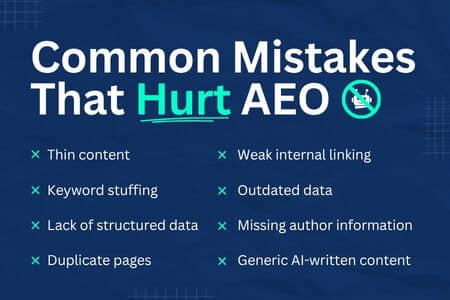
Even well-intentioned SEO efforts can undermine AEO performance. Here are the mistakes that show up most often, and why each one makes it harder for AI systems to trust and cite your content.
- Thin content. Pages that touch on a topic without fully answering the question give AI systems little to work with. If a page can’t stand alone as a complete answer, it’s unlikely to be selected as one.
- Keyword stuffing. Repeating a target phrase unnaturally throughout a page reads as low quality to both readers and AI models, which are trained to favor natural, conversational language over forced repetition.
- Lack of structured data. Without schema markup, AI crawlers have to infer what a page is about instead of reading it directly, which makes your content easier to overlook in favor of a page that spells it out.
- Duplicate pages. When multiple pages target the same topic or question, they compete against each other rather than building one strong, authoritative source, diluting the signal AI systems use to decide what to trust.
- Weak internal linking. Pages that exist in isolation, with no links to or from related content, make it harder for AI systems to understand how your site’s expertise fits together.
- Outdated content. Information that hasn’t been reviewed in months or years signals to AI systems that a page may no longer reflect the current, accurate answer.
- Missing author information. Content with no visible author or credentials behind it is harder to evaluate for expertise and trustworthiness, two of the signals AI systems weigh most heavily.
- Generic AI-written content. Text that reads as a broad overview with no unique insight, data, or perspective is easy for AI systems to find equivalent versions of elsewhere, which lowers the odds it gets chosen and cited.
Signs Your Website Isn’t Ready for AI Search
A few warning signs tend to show up together on websites that are falling behind in AI-driven search. Here’s what to look for, and what each one usually points to.
- Low visibility in AI Overviews. If your pages rarely, if ever, appear in AI-generated summaries for topics you’d expect to rank for, it’s a sign AI systems aren’t finding your content authoritative enough to cite.
- Limited topical authority. Covering a subject in one or two scattered articles, rather than a connected cluster of content, makes it harder for AI systems to see your site as a go-to source on that topic.
- Few or no FAQ sections. Without question-and-answer content, your pages miss an easy, direct format that AI tools are built to pull answers from.
- Missing schema markup. Without structured data, AI crawlers have to guess at what a page is about instead of reading it directly.
- Thin service pages. Pages that briefly describe a service without real depth give AI systems little reason to choose them over a more comprehensive competitor.
- Weak local SEO signals. Inconsistent business information, few reviews, or an incomplete Google Business Profile all make it harder to surface in local AI search results.
- Poor page structure. Content without clear headings, logical flow, or scannable sections is harder for both readers and AI systems to parse and extract answers from.
- An outdated content strategy. A publishing approach that hasn’t evolved to reflect how people search today, through full questions and conversational queries, will struggle to keep pace with AI-driven search.
If several of these sound familiar, it’s worth taking a closer look at how well your site is set up to optimize for AI search.
Why Partner with Oyova for SEO & AEO
Improving Answer Engine Optimization (AEO) touches nearly every part of a website, from technical infrastructure to content strategy to local presence, which is why many businesses turn to an Answer Engine Optimization service rather than tackle it piecemeal.
Oyova brings that full range of expertise together under one roof, including:
- Technical SEO expertise
- Content strategy
- Custom website development
- Local SEO experience
- Data-driven marketing
- Schema implementation
- AI search optimization
For businesses trying to keep pace with how quickly search is evolving, that kind of full-service approach makes it far easier to stay visible as AI answer engines continue to shape how customers find and choose companies to work with.
Is Your Website Ready for AI Search?
Search isn’t waiting for businesses to catch up. AI Overviews, ChatGPT, Perplexity, and other answer engines are already deciding which sources get seen and which get skipped every day.
Answer Engine Optimization (AEO) is still a new and evolving discipline, and most businesses simply don’t have the internal bandwidth to track every shift in how these tools evaluate and cite content. That’s where an experienced marketing partner makes the difference.
If you’re not confident your website is positioned to compete in this new search landscape, now is the time to find out. Reach out to Oyova to talk through where your site stands today and what it would take to earn a place in tomorrow’s AI-generated answers.
FAQs
Answer Engine Optimization (AEO) is the practice of structuring website content so AI-driven search tools like Google AI Overviews, ChatGPT, and Perplexity can easily understand, trust, and cite it in generated answers.
Traditional SEO focuses on ranking a page within search results, while AEO focuses on becoming a source an AI system chooses to summarize or cite directly in its response. The two share many of the same fundamentals, but AEO places extra emphasis on clarity, structure, and trust signals.
AEO and generative engine optimization (GEO) are closely related terms that both describe optimizing content for AI-driven answer generation. Many marketers use them interchangeably, though GEO is sometimes used more specifically in reference to generative AI platforms.
Yes. AI Overviews draw heavily from well-optimized, authoritative, and clearly structured pages that already perform well in traditional search, making strong SEO a foundation for AI Overview visibility.
It can. That’s more likely to happen when browsing is turned on, and there’s solid, credible, well-structured content about your business already out there for the model to find.
Focus on comprehensive, intent-driven content, question-based structure, strong EEAT signals, schema markup, solid internal linking, and up-to-date technical SEO.
Yes. Schema markup gives AI crawlers explicit, machine-readable context about your content, making it easier for them to interpret and trust what your pages are about.
Very. Experience, expertise, authoritativeness, and trustworthiness are central to how both traditional search engines and AI systems evaluate whether a source is credible enough to cite.
Yes. Businesses that maintain a strong Google Business Profile, consistent NAP information, and locally focused content have a better chance of appearing in local AI-driven search results.
Yes. Refreshing statistics, examples, and FAQs on existing content helps signal freshness and relevance, both of which influence whether AI systems continue to trust and cite a page.
No. AEO builds on SEO fundamentals rather than replacing them. Businesses still need strong technical SEO and quality content as the foundation for AEO to work.
Timelines vary depending on a site’s starting point, but most businesses see meaningful improvement over several months of consistent content, technical, and structural updates.
Related Posts

What Can Developers Do With AI Web Design?
AI can put together a good-looking website surprisingly fast. But you may not anticipate the more complicated issues...
Read More
DIY AI Website Design: What It Could Cost Your Business
You type in your business name, answer a few prompts, and thirty seconds later you have a website....
Read More
Are Websites Built with AI Builders SEO-friendly? What You Need to Know
AI can be useful when building a website, but using an AI builder doesn’t automatically make a site...
Read MoreOur Awards