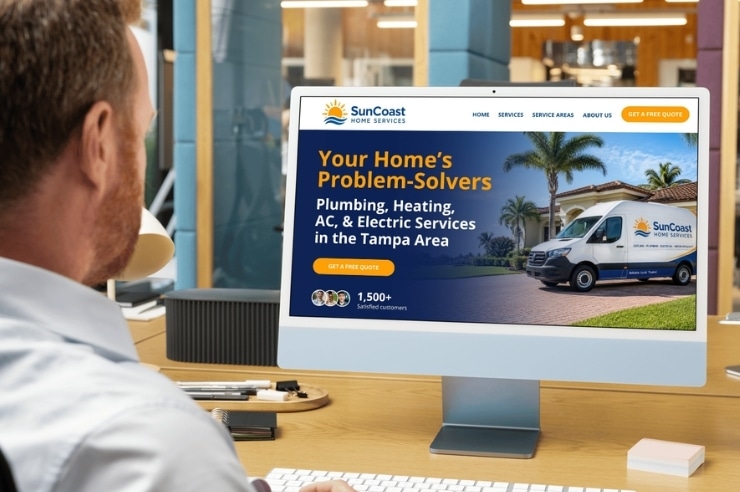
In 2026, homeowners don’t flip through the Yellow Pages or ask around the neighborhood before hiring a plumber, roofer, or landscaper. They pull out their phones and start searching. If your home services website isn’t ready to meet them at that moment with speed, clarity, and confidence, you’re already losing to a competitor who is.
The stakes are higher than most home service business owners realize. Your website isn’t just a digital placeholder. It’s the first impression, the trust signal, and the closing pitch all wrapped into one. And if it falls short in even a few key areas, the cost of missed leads and lost revenue can be staggering.
Not getting the results you want from your home services website? Here are 10 reasons it may be falling short and how to turn things around.
Your Website Should Be Your Best Salesperson
Think about your best salesperson. They show up on time, explain your services clearly, handle objections before they’re raised, and make it easy for customers to say yes. Your website should do all of that, even at 2 a.m. on a Tuesday when no one on your team is available.
Too many home service companies treat their website as an online brochure: a static page with a logo, a list of services, and a phone number. But a high-performing website actively works to turn visitors into booked appointments. It answers questions, establishes credibility, and guides users toward action.
When a website fails at this, the consequences are measurable. Higher bounce rates, lower conversion rates, fewer calls, and ultimately, thousands of dollars in missed opportunities every single month. Small friction points, such as slow load times and a confusing layout, compound quickly with hundreds of monthly visitors.
The good news? These problems are fixable. Let’s walk through the most common culprits.
Not sure where your website stands? Get a free web consultation from Oyova and find out what’s holding your site back.
Reason #1: Your Website Loads Too Slowly
If your website takes more than three seconds to load, a significant portion of your visitors are already gone. Page speed is one of the most critical factors in both user experience and search engine rankings, yet it’s one of the most commonly neglected issues on home services websites.
The relationship between slow websites and higher bounce rates is well-documented. When someone searches for an emergency plumber or a same-day HVAC repair, they’re not going to wait around. They’ll hit the back button and click the next result.
What You Can Do
- Compress and optimize all images before uploading.
- Enable browser caching and use a content delivery network (CDN).
- Minimize unused JavaScript and CSS.
- Choose a fast, reliable hosting provider.
- Use tools like Google PageSpeed Insights to identify specific bottlenecks.
Speed improvements often deliver an immediate and measurable boost in conversions. Making this one of the highest-ROI fixes available.
Reason #2: It Isn’t Mobile-Friendly
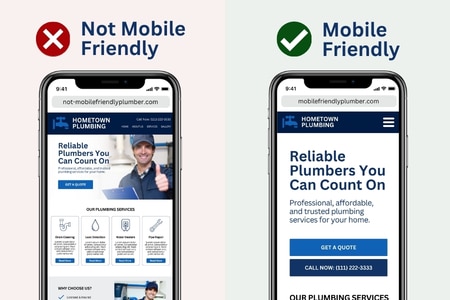
The majority of home service searches happen on mobile devices. Someone’s toilet is overflowing, their AC just died in July, or they’re standing in their backyard trying to figure out who to call for a fence installation. They’re searching on their phone.
If your website isn’t optimized for mobile users, you’re creating a frustrating experience for your most likely leads. Common mobile usability mistakes include tiny text that requires zooming, buttons too small to tap accurately, horizontal scrolling, and pop-ups that cover the entire screen.
What Mobile Users Expect
- Fast load times (even on slower cellular connections)
- Click-to-call phone numbers
- Easy-to-fill contact forms
- Clear navigation that works with a thumb, not a mouse
- Location and service information front and center
A mobile-first design approach isn’t optional anymore. It’s a baseline requirement for any competitive home services website design.
Reason #3: Visitors Can’t Tell What You Do Within Seconds
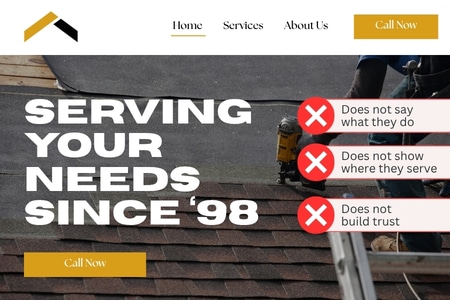
You have about five seconds to answer three questions in a visitor’s mind:
- What do you do?
- Do you serve my area?
- Can I trust you?
If your homepage doesn’t answer those questions immediately, most visitors will leave.
This is as much a messaging problem as a design problem. Vague headlines like “Serving Your Needs Since 1998” or “Quality You Can Count On” don’t tell anyone anything. Neither does burying your service list three scrolls down the page.
How to Fix Your Value Proposition
- Lead with a clear, specific headline: “Jacksonville’s Most-Trusted Roofing Company” or “Same-Day Plumbing Repairs in Tampa Bay.”
- List your core services visibly above the fold.
- Include your service area prominently in the header, hero section, and footer.
- Use plain language that matches how customers search, not internal company jargon.
The goal of web design for home services businesses is to ensure a first-time visitor immediately understands who you are, what you do, and why they should call you rather than the next result.
Reason #4: Your Website Doesn’t Build Trust
Home service companies are asking customers to invite strangers into their homes. That’s a significant trust barrier, and your website needs to clear it before a visitor will ever pick up the phone.
Yet many home services websites are missing the most basic trust signals. No customer reviews. No before-and-after photos. No mention of licenses or certifications. No guarantee or warranty information. The absence of this critical information doesn’t just fail to build confidence. It actively raises doubts.
Trust Signals That Convert
- Google reviews and third-party testimonials are displayed prominently.
- Industry certifications and licensing information (with badge graphics where available).
- A satisfaction guarantee or service warranty.
- Real photos of your team and completed projects (not stock photography).
- Years in business and local community involvement.
- Case studies or detailed project breakdowns for higher-ticket services.
Every trust signal you add is another reason a hesitant visitor chooses to call you rather than a competitor.
Reason #5: Your Calls-to-Action Are Weak or Missing
A call-to-action (CTA) is the bridge between an interested visitor and a lead who’s taken action. If your CTAs are buried, vague, or absent entirely, you’re leaving conversions on the table at every stage of the visitor journey.
Common CTA mistakes on home services websites include using generic phrases like “Contact Us” or “Learn More,” placing the only CTA at the very bottom of the page, and failing to match the CTA to the visitor’s intent.
Effective CTA Strategies for Home Service Businesses
- Use action-oriented, specific language: “Schedule Your Free Estimate,” “Get a Same-Day Quote,” or “Book a Service Call Now.”
- Place CTAs above the fold, after key sections, and in the header/navigation.
- Offer multiple pathways: a phone number for urgent needs, an online form for planned services, and a chat option for quick questions.
- Use contrasting colors to make CTAs stand out visually.
Your CTAs should feel like a natural next step. Not a sales push. When done right, they guide visitors seamlessly toward becoming customers.
Every day your website underperforms is a day your competitors are getting the calls you should be getting. Let’s fix that.
Reason #6: Your Local SEO Is Falling Short
You could have the most beautifully designed home services website on the internet, but if it doesn’t show up when someone searches “roof repair near me” or “best HVAC company in [your city],” it might as well not exist.
Local SEO is the engine that drives organic lead generation for home service companies. And for most, it’s significantly underdeveloped.
Common Local SEO Gaps
- No dedicated location pages for each city or service area you cover
- Missing or inconsistent Google Business Profile information
- No locally-relevant content (blog posts, FAQs, landing pages) targeting service-area keywords
- Lack of local backlinks from community organizations, suppliers, or local directories
- No structured data markup (schema) to help search engines understand your services and location
Fixing your local SEO is one of the most impactful long-term investments you can make in your home services marketing. Rankings compound over time, meaning the work you do today continues generating leads months and years down the road.
Reason #7: You’re Not Showcasing Your Work

Home services are inherently visual. Whether you’re a landscaper, a painting contractor, a remodeling company, or an electrician finishing a panel upgrade, the work speaks for itself, but only if you show it.
Before-and-after photos are among the most persuasive content a home service company can publish. They make abstract promises concrete, help customers visualize what’s possible, and demonstrate the quality of your work in a way that no amount of marketing copy can match.
How to Showcase Your Work Effectively
- Create a dedicated project gallery organized by service type.
- Include sets of before-and-after photos with brief descriptions.
- Add short video walkthroughs for larger projects.
- Use real photos from your own jobs — not manufacturer stock images.
- Include location details in captions to reinforce local relevance.
If your website is all text and no visuals, you’re missing a major opportunity to differentiate yourself and build the kind of confidence that leads to booked jobs.
Reason #8: Your Website Isn’t Generating Leads Efficiently
Lead generation isn’t just about traffic. It’s about removing every possible obstacle between a visitor’s interest and their decision to contact you. The more friction in that journey, the more leads you lose.
Two of the biggest friction points on home services websites are overly complicated contact forms and the lack of online booking. Asking for ten fields of information before someone can request a quote is a fast way to lose them. And in an era where customers can book a restaurant table or a hotel room in thirty seconds, expecting them to call during business hours for a service estimate feels outdated.
How to Reduce Friction
- Simplify contact forms to only the essential fields: name, phone number, service needed, and preferred contact time.
- Offer online booking or instant scheduling where possible.
- Make your phone number click-to-call and visible on every page.
- Use live chat or chatbot tools to capture visitors outside business hours.
- Follow up quickly — response time is a conversion factor in itself.
The easier you make it to take the next step, the more leads your home services website will generate.
Reason #9: You’re Not Tracking Website Performance
If you don’t know how your website is performing, you can’t improve it. Yet a surprising number of home service companies have no analytics setup, or have Google Analytics installed but never look at it.
Data is the difference between guessing what’s working and knowing. Without it, you’re essentially running your marketing on instinct, which means budget that could be optimized continues to underperform.
Key Metrics Every Home Service Company Should Monitor
- Traffic by source (organic search, paid ads, referrals, direct)
- Bounce rate and average session duration
- Conversion rate on key pages (contact, booking, service pages)
- Top-performing landing pages and underperforming ones
- Phone call tracking (which pages and campaigns are driving calls)
- Local keyword rankings over time
When you track these metrics consistently, patterns emerge. You start to understand which services generate the most interest, where visitors drop off, and which changes move the needle. That’s how you improve your marketing ROI month after month.
Reason #10: Your Website Looks Outdated
Design credibility is real. Visitors make subconscious judgments about your professionalism and trustworthiness within seconds of landing on your site, and an outdated design can undermine all the other work you’ve done to earn their business.
Signs your website might be hurting your brand include cluttered layouts, outdated color schemes, pixelated or low-quality images, fonts that haven’t been fashionable since 2012, and a design that looks noticeably different on desktop versus mobile.
When to Consider A Website Redesign
- Your website is more than four or five years old.
- You’re embarrassed to share your URL with potential customers.
- Your competitors’ websites look significantly more professional.
- Your conversion rates have been declining without a clear cause.
- Your branding has evolved, but your website hasn’t kept up.
A modern, professionally designed website doesn’t just look better; it performs better. It performs better. Clean layouts, clear hierarchy, and contemporary visuals signal to visitors that your business is current, credible, and worth calling.
How to Turn Your Home Services Website Into a Lead-Generating Machine
Addressing one or two of the issues above will help, but the biggest gains come from a comprehensive approach that aligns your website strategy with your actual business goals.
That means thinking beyond individual fixes and instead building a cohesive digital foundation: a design that reflects your brand and builds trust, a content strategy that targets the right local keywords, and a user experience optimized to convert visitors at every stage of their journey.
The 3 Pillars of a High-performing Home Services Website
- Design and credibility: A professional, mobile-first design that immediately communicates who you are, what you do, and why you’re the right choice.
- Local SEO and visibility: Content, structure, and technical optimization that help you rank where your customers are searching.
- Conversion optimization: Clear CTAs, frictionless lead forms, trust signals, and performance tracking that turn traffic into booked jobs.
When these three elements work together, your website stops being a cost center and becomes your most productive source of new business — working around the clock in every neighborhood you serve.
Your Home Services Website Should Work as Hard as You Do

You didn’t build your home service business by cutting corners. Your website shouldn’t either. At Oyova, we specialize in building websites for home service companies that are fast, mobile-optimized, locally visible, and designed to convert visitors into paying customers.
We’ve worked with contractors, HVAC companies, landscapers, and plumbers across the country, including in Jacksonville and St. Petersburg, FL, who were tired of watching leads slip through the cracks of an underperforming site. The result every time: a website that stops being a liability and starts being their best source of new business.
The difference between where your website is now and where it needs to be is the right team. Discover what Oyova’s Web Development services can do for your business.
FAQs
There are several common culprits: slow page load times, poor mobile experience, weak or missing calls-to-action, lack of trust signals, and underdeveloped local SEO. Most home service websites struggle with a combination of these issues rather than just one. A comprehensive website audit is often the best starting point to identify exactly where leads are being lost.
Absolutely. Studies consistently show that even a one-second delay in page load time can significantly reduce conversions. For home service customers, many of whom are searching urgently on mobile devices, a slow website often means they leave before they see your offer. Improving page speed is one of the highest-ROI website investments you can make.
The majority of local service searches happen on smartphones. Whether someone needs an emergency repair or is researching contractors for an upcoming project, they’re very likely using a mobile device. If your website isn’t optimized for mobile, with fast load times, easy navigation, and click-to-call functionality, you’re creating a poor experience for your most likely prospects.
Yes. A beautifully designed website that doesn’t appear in local search results will generate very little organic traffic. Local SEO, including location pages, Google Business Profile optimization, local keywords, and structured data, connects your website to customers searching in your service area. Without it, even a well-built site will struggle to drive consistent leads.
At a minimum, your website’s content should be reviewed and refreshed at least once a year, if not twice, to ensure accuracy and relevance. From a design standpoint, a full redesign every three to five years is a reasonable benchmark for staying competitive and maintaining credibility. That said, performance improvements, new service pages, and SEO updates should be ongoing. Not a once-a-year project.
Related Posts

ADA Website Accessibility Remediation: What to Expect & How It Works
Many websites that look and work great may still need website accessibility remediation, and most owners don’t find...
Read More
Website Accessibility Audit Cost and What Drives It
If you’ve started researching website accessibility audits, you’ve probably noticed there’s no one-size-fits-all price. Some websites can be...
Read More
Google Local Services Ads Are Moving to Performance Max: What Your Business Needs to Know
Google Local Services Ads are changing in 2026. Google is moving these campaigns from the separate Local Services...
Read MoreOur Awards