
In 2025, businesses faced more than 3,100 website accessibility lawsuits in federal court alone, a 27% jump from the year before, according to an analysis by Seyfarth Shaw. That figure doesn’t even count the thousands of demand letters that get resolved quietly before a case ever reaches a courtroom. If you’re trying to learn more about ADA website compliance lawsuits because you’re worried your business is at risk, it’s important to understand that your website can get sued just as easily as a physical storefront. Most business owners learn that the hard way.
The good news is you can get ahead of an ADA website compliance lawsuit before it costs you. In this article, we cover why your business can be sued in the first place, what typically triggers these lawsuits, what it could cost you, how to check whether your site is compliant, and how to get any issues resolved.
Can Your Website Get Sued Over ADA Compliance?
Yes, and it’s already happening to businesses like yours. Title III of the Americans with Disabilities Act bans discrimination in places of public accommodation, and courts keep ruling that a business website counts, right alongside its physical doors.
The case that proves it is Robles v. Domino’s Pizza. What happened? A blind customer couldn’t order from Domino’s app or website with his screen reader, so he sued. The Ninth Circuit agreed the ADA applied, since the website sells the same pizza the stores do. The Supreme Court refused to hear Domino’s appeal, so the ruling stands.
Here’s where most business owners get confused. That DOJ rule everyone talks about, the one requiring WCAG 2.1 Level AA, only applies to Title II, meaning state and local governments, not private businesses like yours. You’re covered under Title III instead, and that law never got its own technical standard. Courts use WCAG 2.1 AA anyway, so that’s still what you’ll be judged against.
No law says outright, “your website must be ADA compliant.” But courts keep ruling that Title III covers websites tied to real sales. Treat yours as covered, and you’ll be on the safe side.
What Triggers ADA Website Compliance Lawsuits
Most ADA website lawsuits don’t start with one frustrated customer. A small group of plaintiffs and law firms scan hundreds of business websites at a time, looking for the same easy-to-document violations. When they find one, they send a demand letter or file suit.
Critics call these “drive-by” lawsuits. Supporters say they’re one of the only ways this decades-old law actually gets enforced online. Either way, the exposure is real.
ADA website compliance lawsuits tend to target the same handful of issues, over and over.
- No alt text on images or icons, so screen readers have nothing to announce.
- Checkout forms that only work with a mouse, not a keyboard.
- Text that’s too low-contrast for anyone with low vision to read comfortably.
- Videos with no captions.
- Pop-ups that trap keyboard focus and won’t close without a mouse click.
None of these require a full website redesign to fix. They’re surface-level, well-documented gaps that a proper accessibility audit catches in a single pass, and our article on examples of non-ADA-compliant websites shows what several of them look like in practice.
Website Accessibility Lawsuit Examples and Settlement Amounts
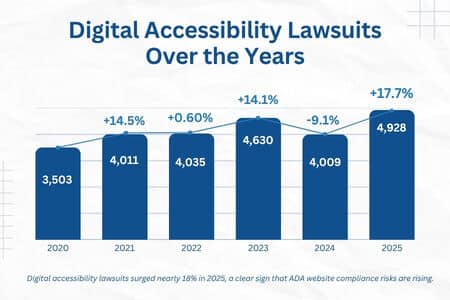
Knowing what triggers a lawsuit is one thing. Seeing what actually happens once one is filed, and what it costs, makes the risk a lot more concrete.
Real ADA Lawsuit Examples
These cases show just how differently an ADA website lawsuit can play out. One set the standard everyone still cites. Another resolved nothing at all.
- Robles v. Domino’s Pizza: A blind customer couldn’t order through Domino’s app or website using his screen reader, so he sued. The case became the go-to precedent for applying Title III to business websites, and it ended in a confidential settlement in 2022, after the Supreme Court declined to hear Domino’s appeal.
- Gil v. Winn-Dixie: A Florida trial court originally sided with the plaintiff, finding the grocery chain’s website violated the ADA. The Eleventh Circuit reversed that ruling on appeal. Then the underlying injunction expired, leaving nothing left to decide. Because of this, the court vacated its opinion, and no lasting ruling remained.
- NFB v. Target: Target’s website couldn’t be used with screen-reading software either, and the National Federation of the Blind sued in 2006. The case became the first major precedent establishing that a retailer’s website falls under the ADA when it’s tied to the goods and services sold in its physical stores, and it ended in a $6 million class-action settlement two years later.
Most businesses never experience anything like these headline cases. Instead, a demand letter shows up, citing a few specific WCAG failures. From there, it usually ends quietly. A quick fix, a private settlement, and no courtroom involved.
Settlement and Verdict Amounts
ADA website compliance lawsuit settlement and verdict figures vary widely depending on business size, whether the case is an individual claim or a class action, and how quickly the business responds. A rough picture, based on recent case data:
| Case Type | Typical Range |
| Small business demand-letter settlement | $5,000 – $20,000 |
| Statutory civil penalty, first violation | up to $118,225 |
| Statutory civil penalty, repeat violation | up to $236,451 |
| Large class-action settlement | $5 million – $6 million+ |
Kris Rivenburgh, an ADA compliance consultant who has negotiated hundreds of these cases directly, puts small business demand-letter settlements in the $5,000 to $20,000 range. Statutory civil penalties work differently. Those come from the DOJ’s current inflation-adjusted penalty table under Title III.
Fashion Nova’s 2020 class-action settlement reached $5.15 million, with eligible California customers able to claim up to $4,000 each, and Target settled a similar class action for $6 million years earlier. Those figures get the headlines, but they don’t show what a typical small business actually pays. Most individual claims against smaller businesses resolve in that $5,000 to $20,000 range, on top of the business’s own legal fees and the cost of remediation itself.
How to Minimize the Risk Before It Happens
An ADA website audit is the first step in reducing your exposure to a lawsuit. But keep in mind that it’s different from running a free automated scan and calling it done. A proper audit combines automated testing with manual testing using real screen readers and keyboard-only navigation, which is the only reliable way to catch usability problems automated tools miss entirely.
A free accessibility scanning tool is a reasonable place to start, and it’ll catch plenty of obvious issues. It won’t catch everything, though. ADA widgets have the same limitation. Plenty of businesses install one expecting it to cover them, but courts haven’t treated a widget as a substitute for real compliance, so it’s worth knowing what these tools actually fix and where they fall short.
Not sure what to look for in an ADA compliance agency? Start with these questions before hiring one. The answers can tell you a lot about whether an agency will actually evaluate your website or just run a standard script and hand you a report. You should leave an audit knowing what needs fixing, what deserves attention first, and how those issues affect people using your site.
Wondering if your website is ADA compliant? Contact Oyova today to discuss our ADA compliance audit and remediation services. We’ll help you find ADA compliance issues and fix them to protect your website…and your business.
ADA Website Compliance Takes More Than a Quick Fix
Many businesses install a widget, check the box, and move on. Compliance handled, or so they think.
Except in 2025, about 22.6% of ADA website lawsuits hit businesses that already had one of these widgets running. The FTC even fined accessiBe, one of the bigger widget providers, $1 million for overstating what its tool actually fixed.
A widget can help, but it can’t fix everything. Some accessibility problems are tied to the way the website was built in the first place. Maybe a form doesn’t make it clear what went wrong when someone submits it, or assistive technology isn’t picking up an important piece of information correctly. Fixing those issues means going into the website itself. That’s where a widget falls short.
So what actually works? Fixing the code itself. It takes more time than installing a script, but it closes the specific gaps that show up in demand letters and lawsuits. And if you’ve already gotten one of those letters, this doesn’t change. An audit-backed fix is still the way out.
Legal fees are only part of the bill. A lawsuit can cost you customers and trust too, and the risks of a non-ADA-compliant website go deeper than you might expect.
Protect Your Business from an ADA Website Compliance Lawsuit
ADA website lawsuits have become a growing concern for businesses, but getting sued isn’t inevitable. In many cases, the same accessibility problems show up again and again, and you can address them once you identify them. The bigger problem is assuming the website is fixed after addressing only the issues that appeared in the first complaint.
If you’re trying to avoid a lawsuit or you’ve already received a demand letter, the first step is knowing what you’re dealing with. A thorough website audit can uncover accessibility problems that may otherwise go unnoticed. From there, you can update the website to address those issues instead of relying on a quick fix. Oyova provides ADA website audits and remediation services to help businesses identify accessibility issues and determine what to address.
Ready to get started? Schedule an ADA website audit with Oyova to clearly understand where your website stands and what you can do next.
<hr>
Disclaimer
The information provided in this blog is for general informational purposes only and is not intended as legal advice. The contents of this blog may not reflect the most current legal standards or interpretations. Please consult with a qualified attorney for specific legal advice regarding ADA compliance or other legal issues. Oyova does not guarantee the accuracy, completeness, or usefulness of any information on this site and is not responsible for any errors, omissions, or results obtained from using this information.
<hr>
FAQs
Yes. A website that creates accessibility barriers can put a business at risk of an ADA lawsuit. The risk can be particularly significant for businesses with physical locations or websites that sell products or services online. The ADA doesn’t give private businesses a simple checklist for website accessibility, so WCAG 2.1 Level AA is often used as a practical reference point. The more significant a website’s accessibility problems, the greater the potential legal risk.
No single federal law names a specific standard for private business websites. But federal courts in multiple circuits have ruled that Title III’s public accommodation requirements extend to websites, particularly ecommerce sites, so in practice most businesses that serve the public online are expected to meet WCAG 2.1 AA.
Robles v. Domino’s Pizza and Gil v. Winn-Dixie are the two most cited cases, but most lawsuits never make headlines. Most involve small and midsize businesses that receive a demand letter about specific accessibility gaps, like missing alt text or an unusable checkout form, and settle privately before the case ever reaches court.
Related Posts
Website Accessibility Audit Cost and What Drives It
If you’ve started researching website accessibility audits, you’ve probably noticed there’s no one-size-fits-all price. Some websites can be...
Read More
8 Most Common Website Accessibility Issues
Website accessibility issues are easy to miss, especially when your site looks and works fine to you. However,...
Read More
Do Websites Have to Be ADA Compliant?
Do websites have to be ADA compliant? In practice, yes. Courts and the Department of Justice treat business...
Read MoreOur Awards