Your crews show up on time, do the work right, and your customers are happy. So why isn’t the phone ringing? Usually it’s not a service quality problem. It’s a sign that your marketing isn’t putting your business in front of homeowners when they’re searching. What you need is a more focused online marketing for home services strategy.
Most homeowners do some research before they call a home service company. They may search Google, read a few reviews, visit your website, or even use an AI tool to find local businesses. That means your company needs to be easy to find and easy to trust before someone is ready to pick up the phone. Having a website, running Google Ads, or posting on social media can help, but those efforts won’t do much if they’re being handled separately.
In this article, we break down the 10 common reasons home service marketing fails to generate leads. Along the way, you’ll find what to fix, how AI search is changing the picture, and how to tell when it’s time to bring in a home services marketing agency.
Why Online Marketing Matters for Home Service Businesses
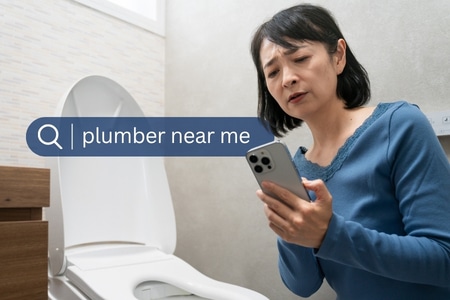
Home services marketing differs from most other industries because nearly every customer searches with both a service and a location in mind. For example, they may use search terms such as “water heater repair Tampa,” “roofer near me,” “emergency plumber open now.” These are high-intent, geographically specific searches, and they show up across more channels than most business owners realize.
Homeowners Are Searching Before They Call
A homeowner looking for services in your area could run into your business almost anywhere. Maybe it’s a plain Google search, or Google Maps while they’re driving around. Maybe it’s your Google Business Profile, an AI chatbot answer, a review on Yelp or Angi, a Facebook post from a neighbor, one of your ads, or your own website.
According to BrightLocal’s 2026 research, 84 percent of consumers had searched for a local business in the past three months, and roughly a third search daily. In other words, this is just how people find a contractor now.
Your Marketing Has to Work Across Multiple Search Channels
That’s a lot of ground to cover. Ranking one page for one keyword isn’t enough anymore. Your marketing needs to show up across local SEO, AI search, paid search, and reviews, because a homeowner might touch several of those before they ever pick up the phone.
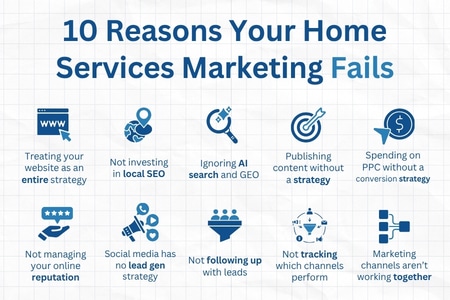
So where’s your marketing actually falling short? Here are 10 of the most common reasons home service marketing fails to generate real leads, and what to do about each one.
10 Reasons Your Online Marketing for Home Services Is Failing
Reason #1: You’re Treating Your Website as Your Entire Marketing Strategy
A website is not a marketing strategy. It’s a destination. No promotion means no traffic. Even the best-designed site can get buried on page five of Google. Real marketing pairs the website with the SEO, paid search, content, social proof, and reviews that actually drive people to it.
Of course, if your website itself is holding you back, that’s worth fixing too. We cover that in detail in 10 Reasons Your Home Services Website Isn’t Cutting It.
Reason #2: You’re Not Investing in Local SEO
Your Local SEO efforts are going to be what separates you from your competitors. If you’ve decided it’s not important, you’ve already sent your customers somewhere else. Investing in Local SEO means that when someone is looking for your services and searches for “electrician near me” or “HVAC repairs in Jacksonville”, you’re right there and can easily be contacted. If you’re not there, your competitor is.
When focusing on Local SEO for home services, there are several factors to consider. Here are some items that you need to prioritize if you want to beat out your competitors:
- Optimize your Google Business Profile
- Build local citations, like Yelp and Angi
- Create location-based service pages on your website
- Get local backlinks from local organizations and associations
- Make sure your business name, address, and phone number (NAP) is consistent online
- Get positive reviews as soon as possible
- Make sure your website pages have the right local schema markup
Together, these signals help search engines understand who you serve and where.
Your Google Business Profile Is Underoptimized
Your Google Business Profile is often the very first impression a homeowner gets. If your services, hours, service areas, photos, and recent updates aren’t current, you’re handing that first impression to a competitor with a better-maintained profile.
Reviews are also crucial in convincing someone to contact your business. You need to make sure customers are sharing their positive experience on your Google My Business profile as soon as the services are done – when it’s top of mind. And you have to keep them coming and be responsive. They can’t be an afterthought. A positive review here and there with little to no response won’t cut it. They need reassurance you can be trusted.
You’re Not Creating Location-Specific Content
Location pages are dedicated pages on your website for each city or service area you cover. They help you rank for searches tied to a specific place.
But they only work when they’re useful. A page for “plumber in Tampa” or “roofing contractor in Orlando” should speak directly to that market, covering local permitting quirks, common seasonal issues, neighborhoods served, and real local proof. Not a city name swapped into a template with thin, duplicated content built purely to catch a keyword.
Reason #3: You’re Ignoring AI Search and GEO
This is one of the fastest-moving shifts in how home service businesses get found. Customers increasingly research contractors through AI-powered experiences like Google’s AI Overviews, ChatGPT, Gemini, and similar tools that summarize an answer before a user ever clicks a website. And it’s happening fast. Consumer use of AI tools to find local businesses jumped from 6 percent to 45 percent in a single year, according to BrightLocal’s Local Consumer Review Survey.
Traditional SEO Isn’t the Only Visibility Goal Anymore
Traditional SEO is about ranking a page. Generative engine optimization (GEO) and answer engine optimization (AEO) are about something different. They focus on getting your business mentioned and recommended in an AI-generated answer. The fact is, SEO isn’t enough. You now need to incorporate both.
Build the Signals AI Search Uses to Understand Your Business
AI tools don’t pay attention to businesses that focus on the foundation. They boost businesses that do the basics right. So what does that mean? Well, here are some items you must have in order to gain favor with the AI gods.
- Service pages that have clear messaging
- Accurate location information
- Consistent and positive recent reviews
- Your business information online is consistent (Remember NAP!)
- You have FAQs on your website that address common questions
- Website content they can trust
- Local schema markup and other appropriate schema data
- Third-party mentions, like online reviews or mentions from an industry expert
If these signals are inconsistent or just don’t exist, AI will ignore you. And, let’s face it, so are your customers.
Reason #4: You’re Publishing Content Without a Strategy
Publishing content isn’t the same as having a content marketing strategy. That applies whether it’s blog posts, videos, guides, FAQs, or the copy on your service and location pages. Content created without keyword research, a clear connection to your services and service areas, or a path to booking a job might look productive, but it won’t move the needle on leads.
Create Content Around the Customer Journey
A homeowner doesn’t go from “I have a problem” to “I’m ready to book” in one step. They move through a few distinct stages first.
- Figuring out what’s wrong
- Researching solutions
- Comparing a few companies
- Deciding who to call
Your content should meet them at each of those points, not just one, or a competitor will be there for the stages you’re missing.
Connect Content to Revenue-Generating Service Pages
Every piece of content should point back to your service pages, not sit off on its own. A home services marketing plan built around this kind of internal linking helps search engines connect your content to the pages that actually generate revenue.
Reason #5: You’re Spending Money on PPC Without a Conversion Strategy
PPC can generate leads fast. It can also drain your budget fast. Here’s where that money usually leaks out.
- Targeting cast too wide to reach the right homeowners
- Keywords picked without much research behind them
- Ads sending clicks to your homepage instead of a page built for what was promised
- No call tracking, so you can’t tell which ads are actually working
- Weak geographic targeting that wastes clicks outside your service area
- No negative keyword list to filter out irrelevant searches
- No way to tell a homeowner who’s ready to hire from one who’s still browsing
Most of the time, PPC gets blamed for underperforming when the real problem is how the campaign was set up in the first place.
Your Ads and Landing Pages Need to Match
Let’s say your online ad promises 24/7 emergency service. The click should land on a page built around 24/7 emergency service with a click-to-call number front and center. No digging required. It should not link to your homepage or a general service page.
Marketers call this message match, and it’s one of the easier PPC fixes to make. A confused homeowner doesn’t stick around to figure out your site. They hit back and click the next result. Fix the mismatch, and you’ll typically see lower cost per lead alongside a better conversion rate.
Reason #6: You’re Not Managing Your Online Reputation
Home services is uniquely personal. Homeowners are inviting a stranger into their house, so showing you’re trustworthy is crucial. Here are some ways you can build trust with potential customers.
- Keep your Google reviews coming in steadily, not just in bursts
- Respond to reviews, good and bad, so people see someone’s actually paying attention
- Handle negative reviews head-on instead of letting them sit unanswered
- Feature reviews and testimonials from real customers
- Post before-and-after photos that prove the work speaks for itself
Skip more than one or two of these, and a competitor with a fuller trust profile gets the call instead.
Reviews Affect Both Rankings and Conversions
Reviews aren’t just reputation management. They influence rankings and buying decisions at the same time.
Star ratings and recent review volume are among the strongest local search ranking factors. Reviews influence buying decisions too. According to BrightLocal’s data, most consumers now walk away from a business over a review issue, whether that’s a negative review, a low rating, or reviews that haven’t been updated in a while.
Don’t Wait for Customers to Leave Reviews
The businesses with the strongest review profiles ask for them. Waiting around for a happy customer to think of it on their own leaves too much to chance, so build in a request right after the job wraps up, while it’s still fresh in their mind.
What does that look like? Well, it can vary. Some companies text a review link the same afternoon a job finishes, since that’s usually when response rates are highest. Others have technicians ask in person on the way out the door, then follow up a day or two later. Whatever method you choose, make sure you’re doing it consistently. Your audience is looking for consistency. So drive those leads!
Reason #7: You’re Using Social Media Without a Lead Generation Strategy
Great! You’re posting on social media. (throws confetti) So is everyone else. The question is, is your social media driving more business? If not, you need to change your strategy.
Posting on social media doesn’t matter if you don’t have the goal of generating leads in mind. If all you’re posting is purely promotion and not showcasing your work and positive feedback, it’s all for naught. Everything becomes background noise instead of a lead source.
Show Your Work
Give people something worth engaging with, and worth sharing. A few content types perform well for home service businesses.
- Before-and-after project photos
- Job-site videos
- Technician tips
- Customer testimonials
- Answers to common homeowner problems
None of it needs to be polished. Homeowners respond to content that feels real, not produced, which is part of why this kind of content tends to outperform anything that looks like a traditional ad.
Build Trust, Not Just Followers
A large following is nice, but it doesn’t mean much if those people never become customers. For home service companies, social media can help keep your business top of mind for potential customers. When something goes wrong at home, you want them to recognize your name and feel comfortable reaching out.
Want to build trust on social media? Here are a few ways to do so:
- Engage with comments instead of just posting and moving on.
- Share content specific to the communities you serve.
- Stay visible between jobs, not just when you’re trying to sell something.
A homeowner who’s seen your work a few times and watched you respond to other customers trusts you more than someone seeing your name for the first time in a search result.
Reason #8: You’re Not Following Up With Leads
Getting a form submission or phone call is only the beginning. If someone takes the time to contact your business, the next step is making sure they hear back from you. Otherwise, the money and effort you put into generating that lead can go to waste.
A missed call or a delayed response can be enough to lose the job. The same goes for estimates you send but never follow up on. This is especially true when someone needs immediate help with a broken water heater, fallen tree, or another urgent problem. By the time you get back to them, they may have already called someone else.
The First Company to Respond Often Has an Advantage
Speed matters more than most home service businesses realize. A homeowner comparing three contractors typically books the one that responds first, especially in urgent or emergency situations. Research from MIT’s Lead Response Management Study, widely cited across the home services industry, found that 78 percent of customers hire the first company to respond, and that responding within five minutes makes a business 21 times more likely to qualify that lead than waiting even 30 minutes.
A great estimate delivered an hour late often loses to a mediocre one delivered in five minutes.
Turn Existing Customers Into Future Revenue
A single completed job doesn’t have to end the relationship. A few follow-up touches turn a one-time customer into a repeat one.
- Maintenance reminders
- Seasonal service outreach
- Cross-selling related services
- Referral requests
- Review requests
Repeat and referral customers are almost always cheaper to win than brand-new ones. There’s no ad spend involved. Trust is already established. Keeping a past customer coming back costs a fraction of what it takes to generate a new lead from scratch.
Reason #9: You’re Not Tracking Which Marketing Actually Generates Customers
Getting traffic to your website is only part of the picture. You also need to know which visitors become leads and, eventually, paying customers. Without that information, it’s difficult to tell which parts of your marketing are actually bringing in business.
For example, a campaign may generate plenty of website visits but very few phone calls or booked jobs. If you aren’t tracking what happens after someone clicks, you could keep spending money on a campaign that isn’t producing the results you need.
Metrics Home Service Companies Should Track
At minimum, track the following.
Visibility metrics
- Organic traffic
- Local search visibility
Lead volume metrics
- Calls
- Form submissions
- Qualified leads
Cost and efficiency metrics
- Cost per lead
- Cost per booked job
- Conversion rate
- Customer acquisition cost
- Return on ad spend
Revenue metrics
- Revenue by marketing channel
Visibility metrics tell you whether people can find you. Lead volume tells you whether they’re reaching out. Cost, efficiency, and revenue metrics tell you whether any of it is actually worth the spend. Tracking only the first two is how businesses end up with plenty of traffic and no clear read on whether their marketing budget is working.
Don’t Optimize for Traffic Alone
More website visitors don’t always mean more customers. A national blog post might bring in thousands of visitors from places you don’t serve, while a local service page could bring in far fewer people but generate more calls and booked jobs.
Chasing traffic volume without tracking what it turns into is one of the quietest ways marketing budgets get wasted.
Reason #10: Your Marketing Channels Aren’t Working Together
Businesses that consistently generate leads usually don’t rely on a single marketing channel. Their SEO, content, paid advertising, reviews, and email efforts all work together.
- SEO helps people find your services through search.
- Content gives potential customers useful information and can help your business appear in AI-powered search results.
- PPC puts your business in front of people who are ready to take action.
- Reviews build credibility and can help turn searchers into customers.
- Email keeps your business in touch with past customers and encourages repeat business.
Each channel has a different role, but they can support one another. When you plan them together, you’re more likely to get value from the time and money you’re putting into marketing.
Should You Hire a Home Services Marketing Agency?

Running everything in-house works fine for some businesses, right up until the gaps start costing real leads. A few signs tend to mean it’s time to bring in outside help.
- You don’t have an internal marketing team, or the team you have is stretched across too many other responsibilities.
- Rankings have stalled despite ongoing effort.
- PPC spend isn’t producing enough qualified leads to justify the cost.
- You don’t know which channels are actually generating customers.
- Competitors consistently outrank you in the same service areas.
- Your business is expanding into new service areas and needs visibility built from scratch.
- You don’t have the time to manage SEO, PPC, content, social, and reputation at once, let alone adapt to AI search on top of it.
If more than one or two of these sound familiar, that’s usually a sign the gaps aren’t going to close on their own.
How Oyova Helps Home Service Businesses Grow Online
Did any of these 10 reasons sound familiar? If so, you need to partner with a trusted home services marketing agency. An agency like Oyova. We do it all from SEO and Paid Ads to website design and development. There’s no marketing problem we can’t solve. That’s why they call us Solutionists. You tell us your goal, and we devise a strategic plan to get there. Everything we do is built and executed with your business goals and success in mind.
So if your current home services website or existing marketing plan isn’t producing the leads it should, give us a call or reach out. We’ll work with you to develop a strategic online marketing plan that delivers results.
FAQs
It’s the combination of SEO, local SEO, content, paid search, social media, reputation management, and AI search visibility that home service businesses use to get found by homeowners searching for a specific service in a specific area.
Most homeowners do some research before choosing a contractor. They may check Google, look at your reviews, visit your website, or search for another company before they ever make a call. If your business isn’t showing up during that process, you may never get the opportunity to earn the job.
There isn’t one channel that works for every home service company. Local SEO, Google Business Profile optimization, paid search, useful content, and a strong review presence all have a role. The right mix depends on your services, competition, and the areas you serve.
Start with the places where you’re losing potential customers. Check your local search visibility, website, Google Ads, reviews, and follow-up process. Fixing a few weak points can make a bigger difference than simply increasing your marketing budget.
There isn’t a standard price. A small service-area business and a company competing in several large markets will have very different needs. Your services, competition, geographic reach, and the channels you use will all affect the cost. An audit can help determine where your budget is best spent.
There’s no set timeline. A new Google Ads campaign might produce a lead within a few days, while a local SEO campaign can take several months to gain traction. Your competition, service area, website, and starting point all affect how quickly you see results.
Related Posts

SEO Marketing for Home Services Companies That Drives More Leads
If someone in your service area searched for what you do right now, would your business show up?...
Read More
Local SEO Marketing for Home Services Companies: Get More Business
A homeowner looking for a plumber, electrician, HVAC company, or roofer will often start with Google. They may...
Read More
Marketing for Home Services: How to Generate More Leads & Scale Your Business
Your team can be the best in town, and you can still watch growth stall out. That’s the...
Read MoreOur Awards