If your business relies on referrals and repeat customers, email marketing for home services might be the most underused tool in your marketing toolbox. Every estimate request, service appointment, and completed job adds another contact to your list. However, most of those contacts never hear from your business again after the invoice is paid. That’s a goldmine sitting untapped.
The good news is that it doesn’t take much to turn that list into a steady source of leads. A well-built home services email marketing program is one of the most cost-effective ways to stay in front of past customers, nurture new leads, and turn one-time jobs into long-term relationships. Whether you run an HVAC company, plumbing business, landscaping crew, roofing company, or pest control service, the right email marketing strategy can keep your phone ringing long after the first job is done.
In this post, we’ll break down why email still works so well for service-based businesses and share five practical tips you can start using in 2026 to generate more leads, more repeat business, and more referrals.
Why Email Marketing Still Works for Home Service Businesses
It’s easy to assume email is old news compared to social media or paid ads, but the data tells a different story. Email marketing consistently delivers one of the highest returns of any marketing channel, with industry benchmarks from Litmus showing returns between $36 and $42 for every $1 spent, the highest ROI of any digital marketing channel, compared to roughly $2 for paid search and $2.80 for social advertising. For home service businesses working with tight marketing budgets, that kind of return is hard to ignore.
Staying Connected with Homeowners

Most home service purchases aren’t impulse buys. A homeowner might think about replacing their HVAC system for months before pulling the trigger, or they might forget about a plumbing issue until it becomes an emergency. Email keeps your brand in front of them during that consideration window, so when they’re ready to act, you’re the first business they think of.
Supporting Lead Generation, Retention, and Referrals
Email isn’t just for new leads. It’s equally powerful for keeping existing customers engaged through maintenance reminders, seasonal tips, and loyalty offers. It’s also great for nudging satisfied customers to leave reviews or refer friends and neighbors.
Why Many Home Service Companies Leave Money on the Table
Despite the high ROI, many home service businesses still don’t have a real email strategy. They collect emails at the point of sale and never use them again, or they send occasional promotional blasts with no automation or segmentation. Email marketing consistently ranks among the top two most-used marketing channels across business sizes, according to the HubSpot State of Marketing Report. With email remaining a core channel alongside social media and websites, businesses that build a consistent, automated email program gain a real competitive advantage over those that don’t.
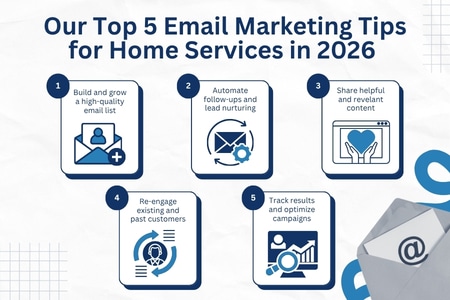
Our Top 5 Email Marketing Tips for Home Services in 2026
1. Build and Grow a High-Quality Email List
Everything starts with your email list. The good news is that home service businesses have more natural opportunities to collect emails than almost any other industry. Every quote request, booked appointment, and service call is a chance to grow your list.
- Collect emails through website forms, quote requests, and service appointments. Ensure every contact point on your site, such as quote forms, scheduling tools, and contact pages, requires an email address. If your website isn’t generating enough leads or capturing email addresses effectively, it may be suffering from common home services website issues that reduce conversions.
- Offer valuable incentives such as maintenance guides or seasonal checklists. A “Winter HVAC Maintenance Checklist” or “5 Signs Your Roof Needs Repair Before Storm Season” gives homeowners a reason to hand over their email and positions your business as the local expert.
- Focus on quality subscribers over quantity. A smaller list of homeowners in your actual service area who are genuinely interested in your services will always outperform a large list full of unqualified contacts. Quality over quantity also protects your sender reputation and keeps your emails out of spam folders.
If you’re still relying on spreadsheets or sticky notes to track leads, it might be time to consider how a digital marketing strategy and proper lead-tracking tools can help you capture and organize this information automatically.
2. Automate Follow-Ups and Lead Nurturing
One of the biggest advantages of email marketing is automation. Once you set up the right sequences, they work around the clock. Following up with leads, confirming appointments, and nurturing prospects without anyone on your team lifting a finger.
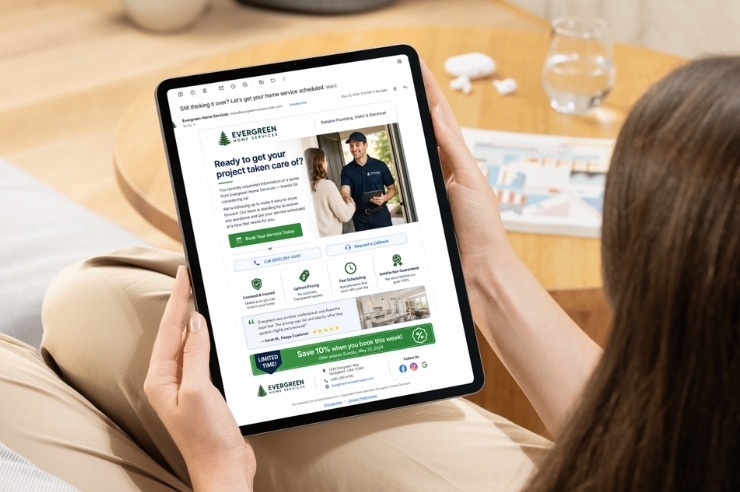
- Welcome emails for new leads. When someone requests a quote or signs up for your newsletter, an automated welcome email introduces your company, sets expectations, and may include social proof, such as reviews or before-and-after photos.
- Appointment reminders and confirmations. Automated reminders reduce no-shows and last-minute cancellations, which directly protect your technicians’ schedules and your revenue.
- Follow-up campaigns that keep your business top-of-mind. Not every lead converts immediately. A simple drip sequence, such as a follow-up a few days after a quote, then again a couple of weeks later, keeps your business in the running without requiring manual outreach.
- How automation saves time while generating more opportunities. Automated workflows have been shown to deliver dramatically higher returns than one-off campaigns, with some studies finding that automated workflows yield 30x the returns of one-off email campaigns. For a home services business juggling service calls, scheduling, and customer service, that kind of “set it and forget it” efficiency is invaluable.
If your team is currently sending these emails manually (or not sending them at all), this is one of the fastest ways to free up time while improving conversion rates.
3. Send Helpful, Relevant Content
Not every email needs to be a sales pitch. In fact, some of the most effective emails for home service businesses don’t ask for anything. They simply provide value.
- Home maintenance tips and seasonal advice. Reminders to change HVAC filters before summer, winterize sprinkler systems, or clean gutters before fall storms give homeowners genuinely useful information while subtly reminding them that your team handles these services.
- Service reminders that align with customer needs. If a customer had their water heater serviced a year ago, a friendly reminder that annual maintenance is due (and easy to schedule) can generate a booked job with very little effort.
- Educational content that builds trust and authority. Explaining why a strange noise from their AC unit might be a bigger problem or what to look for after a storm positions your company as the trusted expert. Not just another contractor trying to make a sale.
- Balancing value-driven content with promotional offers. A good rule of thumb is to send several helpful, non-promotional emails for every one promotional email. This keeps your list engaged and prevents subscribers from tuning out or unsubscribing.
It’s a principle we apply across all of our digital marketing services: build trust first with helpful content, and the sales conversation becomes much easier when it happens.
4. Re-Engage Existing and Past Customers
New leads get all the attention, but your existing customer list is often your most valuable (and most overlooked) asset.
- Why repeat customers are often your most profitable leads. Past customers already trust you, already know your pricing, and are far easier to convert than cold leads. A simple “it’s been a year since your last service” email can generate booked appointments with minimal effort.
- Maintenance plan promotions and service reminders. If you offer maintenance plans or service agreements, email is the perfect channel to promote these recurring-revenue programs to customers who already know and trust your work.
- Referral requests and loyalty campaigns. Happy customers are often willing to refer friends and family. They just need to be asked. An email campaign offering a small incentive for referrals can be one of the highest-ROI campaigns you run all year.
- Win-back emails for inactive customers. For customers who haven’t booked a service in a while, a “we miss you” email with a special offer can reactivate dormant relationships before they drift to a competitor.
Re-engagement campaigns like these work best when your customer data is organized and easy to segment. If you’re not sure your current systems make that easy, Oyova can help you set up the tools and workflows to keep past customers active and engaged.
5. Track Results and Optimize Your Campaigns
Email marketing isn’t a “set it and forget it” tactic (beyond the automation itself). It’s an ongoing process of testing and refining what works for your specific audience.
- Monitoring open rates, click-through rates, and conversions. These metrics tell you whether your subject lines are compelling, whether your content resonates, and ultimately whether your emails are driving booked jobs.
- Testing subject lines and calls-to-action. Small changes, like testing “Is Your AC Ready for Summer?” against “5 Signs Your AC Needs Service Now,” can have a meaningful impact on open and click rates over time.
- Using performance data to improve future campaigns. Pay attention to which topics, offers, and send times perform best, and let that data shape your content calendar going forward.
- Turning insights into more booked jobs. Ultimately, every metric should tie back to a business outcome. If a particular email consistently drives appointment requests, send more like it. If another consistently underperforms, adjust or retire it.
A note on a common question we hear: “Can home service companies do cold email outreach?” While cold email (reaching out to people who haven’t opted in) is technically possible, it carries significant legal risk under laws like CAN-SPAM and increasingly strict spam filtering by providers like Gmail and Outlook.
For most home service businesses, the better strategy is to build a permission-based list through your website, service calls, and incentives (the tactics covered in tip #1) rather than relying on cold outreach, which can damage your sender reputation and deliverability.
How Email Marketing Fits Into Your Overall Marketing Strategy
Email marketing doesn’t work in isolation. It works best as part of a connected marketing strategy. Staying current with the latest home services marketing trends can help you better integrate email, SEO, paid advertising, and social media into a unified strategy that generates more qualified leads.
Supporting SEO, Paid Ads, and Social Media Efforts
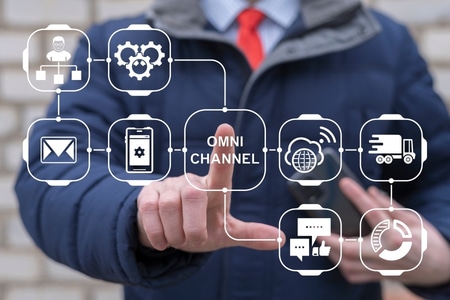
Your blog content, social posts, and paid campaigns all drive traffic to your website. Email captures that traffic and keeps visitors engaged even after they leave your site. A homeowner who reads your blog post about furnace maintenance and signs up for your newsletter might not be ready to book today, but six months later, when their furnace starts making noise, your email reminder could be what brings them back.
Increasing Customer Lifetime Value
A customer who only ever books one service has a fraction of the lifetime value of a customer who’s enrolled in a maintenance plan, opens your seasonal tip emails, and books additional services as needs arise. Email is one of the most effective tools for increasing that lifetime value without increasing your acquisition costs.
Creating a Predictable Pipeline of Leads
When email marketing is automated and integrated with your other channels, it creates a steady, predictable flow of warm leads; people who already know your brand and are more likely to convert when they’re ready to buy. Given that website, blog, and SEO efforts were ranked the #1 ROI-driving channel by marketers in HubSpot’s State of Marketing report, pairing strong content with email nurturing is one of the most effective combinations available to home service businesses.
Generate More Leads with Home Services Email Marketing

Email marketing for home services isn’t complicated, but it does take the right strategy, the right tools, and consistent execution to see real results. From building your list and automating follow-ups to sending content that builds trust and re-engaging past customers, these tips work together to create a steady pipeline of leads and repeat business.
If you’re ready to put a real email marketing strategy in place, or if you already have one but it’s not delivering the results you’d hoped for, Oyova can help. As a full-service digital marketing agency, we work with home service contractors to build email systems that generate more leads, more repeat customers, and more referrals. Let’s build a strategy that fills your schedule and keeps your customers coming back.
FAQs
Yes. Email marketing has consistently delivered one of the highest returns of any marketing channel, with industry data showing returns of $36-$42 for every $1 spent. For home service businesses, email is especially effective because it keeps your company top-of-mind during the months (or years) between service needs.
A well-rounded email program for home service contractors typically includes welcome emails for new leads, appointment confirmations and reminders, seasonal maintenance tips, service reminders, promotional offers, referral requests, and win-back emails for inactive customers.
There’s no single right answer, but a common approach is to send 1-2 emails per month to your general list, with additional automated emails (such as appointment reminders or follow-ups) triggered by specific customer actions. The key is consistency without overwhelming subscribers and ensuring most emails provide value rather than just promoting services.
Email generates leads by keeping your business visible to homeowners who aren’t ready to buy yet, nurturing quote requests that haven’t converted, re-engaging past customers for repeat services, and encouraging referrals from satisfied customers. Combined with automation, email can turn a single point of contact into multiple future opportunities.
Start by capturing emails at every customer touchpoint, including quote request forms, appointment scheduling, and service completion. You can grow your list further by offering valuable incentives, such as seasonal maintenance checklists or home care guides, in exchange for an email address. Focus on building a list of people in your actual service area rather than chasing list size for its own sake.
Related Posts
Email Marketing for Logistics Companies: Automations Oyova Uses to Turn Quote Requests Into Customers
If you run a logistics company, you already know the hardest part isn’t always getting a quote request....
Read More
Is Email Marketing Legit?
As businesses seek to enhance their reach and engagement, many ask, “Is email marketing legit?” The answer is...
Read More
Steal Our Thanksgiving Email Templates (+ 8 Email Dos and Don’ts)
The holiday season, particularly Thanksgiving, offers a golden opportunity for businesses to connect with their clientele on a...
Read MoreOur Awards