
Google Ads vs Meta Ads is one of the first comparisons businesses make when they start planning a paid advertising strategy. Both can bring in leads and sales, but they usually do so in different ways.
Google Ads tends to work around existing demand, reaching people who are already searching for a product, service, or solution. Meta Ads can reach people earlier, often before they have started actively looking, using audience signals such as interests, behaviors, and demographics.
That difference matters because the best platform is not always the one with the cheapest clicks or the biggest audience. It is the one that fits how your customers discover, research, and buy from your business.
Your goals, budget, sales cycle, offer, and customer behavior should all factor into that decision.
Google Ads vs. Meta Ads at a Glance
The quickest way to compare the two platforms is by looking at how they typically reach potential customers.
| Factor | Google Ads | Meta Ads |
| Primary strength | Capturing existing demand | Creating and reaching demand |
| User intent | Often high | Often lower or mid-funnel |
| Targeting | Keywords, location, audiences, search intent | Demographics, interests, behaviors, audiences |
| Creative | Search copy and visual formats | Strong focus on images and video |
| Best for | Services, urgent needs, high-intent searches | Products, brands, offers, visual businesses |
| Lead generation | Strong for intent-driven searches | Strong with good offers and creative |
| Ecommerce | Strong | Strong |
| Retargeting | Yes | Yes |
| Measurement | Leads, CPA, ROAS, revenue | Leads, CPA, ROAS, revenue |
Neither platform is automatically better.
A plumber trying to capture emergency calls has very different advertising needs from an ecommerce brand introducing a new product. The better option is usually the one that fits how customers already discover and buy from that business.
What Are Google Ads?
Google Ads lets businesses advertise across Google’s advertising network, including search results and other placements depending on the campaign type.
Search advertising is especially useful when someone already knows what they need.
Google Ads is particularly relevant when:
- Customers actively search for your product or service.
- The customer has a clear problem or need.
- Your service depends on a particular location.
- The buying decision may happen quickly.
- Search demand already exists.
- A lead or sale is valuable enough to support paid advertising.
For example, someone searching “emergency plumber near me” is already looking for help.
The advertiser does not need to convince that person that plumbing services matter. The goal is to show up at the right moment and turn that search into a call, booking, or form submission.
That is why Google Ads often makes sense for local services, professional services, and products with established search demand.
What Are Meta Ads?
Meta Ads allow businesses to advertise across Facebook and Instagram.
Instead of depending mainly on search terms, Meta can reach people through audience signals such as interests, demographics, behaviors, and previous interactions.
Meta Ads can be useful when:
- Visual creative plays a large role in the sale.
- You need to introduce people to a product or brand.
- You have a strong offer.
- Your audience can be clearly defined.
- Awareness matters before the purchase.
- You have compelling photos or video.
- You want to build remarketing audiences.
Someone scrolling Instagram might see an ad for a fitness program even though they never searched for one.
The ad introduces the offer first. Interest may come before the search.
That difference matters when comparing Meta Ads vs Google Ads.
The Biggest Difference: Intent
The biggest difference between the platforms is often what the customer is doing when they encounter the ad.
| Google Ads | Meta Ads |
| The customer is often actively searching | The customer may simply be browsing |
| The need may already exist | The ad can help create interest |
| Search terms reveal intent | Audience and behavior signals guide targeting |
| Often useful closer to a decision | Often useful earlier in discovery |
| “I’m looking for it.” | “I might be interested in it.” |
Consider two examples.
Someone searches “family lawyer Tampa.” They already know what service they need and are likely comparing options. Google Ads can help a law firm appear during that search.
Now imagine someone sees an Instagram ad titled “What to Do After an Auto Accident: 5 Steps.” They may not have been searching for an attorney. The ad can introduce the firm and create awareness before they actively look for legal help.
This is why Google Ads vs Facebook Ads is not always a direct competition. One platform may capture existing demand, while the other helps generate or influence demand earlier.
Google Ads vs. Meta Ads by Business Type
Different business models create different opportunities on each platform.
Local Service Businesses

Lawyers, plumbers, HVAC companies, roofers, dentists, medical practices, and contractors often have strong search demand.
Someone with a broken air conditioner or an urgent legal issue may search Google immediately. That makes Google Ads especially relevant.
Meta can still support awareness, seasonal promotions, remarketing, and services customers may not think about until they see them advertised.
Ecommerce
Ecommerce businesses often have good reasons to use both platforms.
Google can help capture:
- Product searches
- Shopping searches
- Brand searches
- High-intent shoppers
Meta can support:
- Product discovery
- Promotions
- Catalog advertising
- Creative testing
- Prospecting
- Retargeting
A customer might discover a product through Instagram and later search for the brand on Google before buying.
For ecommerce, Google Ads vs Instagram Ads is often less about choosing one platform and more about deciding what role each should play.
B2B and Professional Services
B2B companies and professional services often have longer sales cycles, so a lead may take more time and several interactions before becoming a customer.
Google Ads can help capture people already searching for a specific solution, while Meta Ads can support awareness, content promotion, and remarketing earlier in the decision process.
For these businesses, lead quality matters most. Ten qualified prospects may be more valuable than 50 low-quality leads.
Metrics such as cost per qualified lead, sales opportunities, customer acquisition cost, and revenue should carry more weight than traffic alone.
Google Ads vs. Meta Ads by Marketing Goal
Your campaign goal can help narrow the choice.
| Goal | Platform to Evaluate |
| Capture active searches | Google Ads |
| Build awareness | Meta Ads |
| Promote visual products | Meta Ads |
| Generate leads from existing demand | Google Ads |
| Introduce a new product | Meta Ads |
| Retarget website visitors | Both |
| Drive ecommerce sales | Both |
| Reach a defined audience | Meta Ads |
| Target specific search terms | Google Ads |
| Capture urgent service needs | Google Ads |
These are starting points, not fixed rules.
A visual brand can still perform well on Google. A local service company can still generate leads through Meta with the right offer depending on your marketing plan.
How Much Does Google Ads Cost vs. Meta Ads?
Cost is an important part of the Google Ads vs Meta Ads comparison, but looking only at cost per click can give businesses the wrong impression.
The cheapest click is not always the cheapest customer.
Google Ads can be more expensive in competitive industries because advertisers are often bidding to reach people who are already searching for a product or service. Meta Ads may bring in lower-cost clicks or impressions in social media, but those users are often earlier in the buying process and may need more time before they convert.
A better comparison looks at what happens after the click:
- Cost per click shows how much you pay to bring someone to your website.
- Cost per lead shows how much advertising spend is required to generate a call, form submission, or other lead.
- Cost per acquisition measures what it costs to generate a customer or another completed business goal.
- Conversion rate shows how often traffic turns into a lead or sale.
- Lead quality helps determine whether those conversions are actually good opportunities for the business.
- Customer acquisition cost compares total advertising spend with the number of customers gained.
- Customer value shows whether the revenue those customers generate supports the advertising cost.
- ROAS compares the revenue attributed to advertising with the amount spent.
Consider a simple example.
Campaign A has a $30 CPC, 10 leads, and 2 customers. Campaign B has a $4 CPC, 50 leads, and 1 customer.
Cheaper traffic does not always mean better results. Total spend, revenue, profitability, and customer value still matter.
That is why Meta Ads is not always cheaper than Google Ads. Costs vary by industry, competition, targeting, location, creative, and customer intent.
What Should Your Google Ads or Meta Ads Budget Be?
There is also no universal monthly budget for Google Ads or Meta Ads.
A useful budget should give the campaign enough room to generate meaningful data while still making sense for the business’s economics. Before setting a number, consider factors such as:
- Search volume and competition, which affect how many potential customers are available and what it may cost to reach them.
- Average CPC and conversion rate, which help estimate how much traffic and how many leads a budget might generate.
- Customer value, which determines how much the business can reasonably spend to acquire a new customer.
- Geographic market, since advertising in one city can require a very different budget from targeting an entire state or country.
- Sales capacity, because generating more leads has little value if the business cannot respond to or close them.
- Testing requirements, especially for new campaigns that need enough data to compare audiences, keywords, offers, or creative.
A few simple formulas can make budget planning more practical.
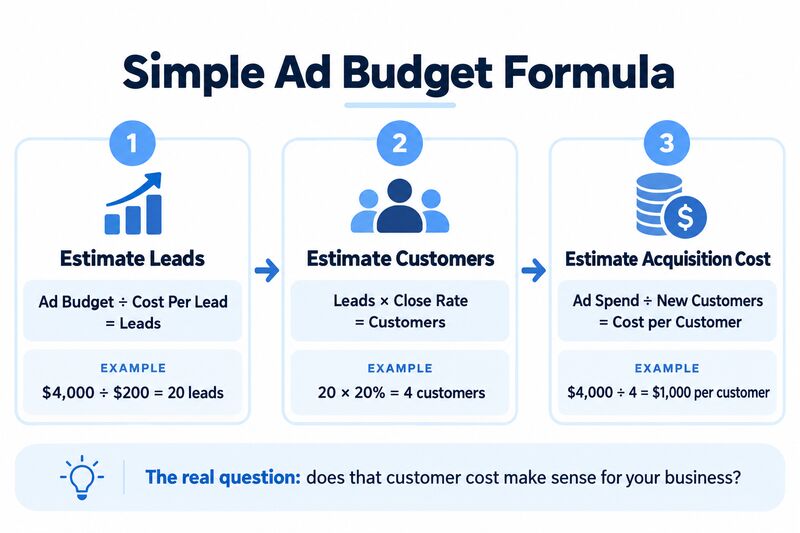
The final question is whether a $1,000 customer acquisition cost works for that business.
For a service where a new customer may generate $10,000 or more in revenue, it could be reasonable. For a low-cost product with a much smaller margin, it may not be sustainable.
Instead of choosing between Google Ads and Meta Ads based on the lowest CPC, businesses should focus on how much it costs to generate qualified customers and how much value those customers create.
How to Decide Between Google Ads and Meta Ads
A few business questions can point you in the right direction.
Choose Google Ads when:
- Customers actively search for what you sell.
- Your company solves a clear or immediate problem.
- You operate in a defined geographic market.
- Valuable search terms are easy to identify.
- You want to capture existing demand.
Consider Meta Ads when:
- Your product is highly visual.
- Your audience can be clearly defined.
- You have strong creative assets.
- You are launching something new.
- You need to build awareness.
- Your offer can get attention while someone browses.
Consider Both when:
- You have enough budget to test multiple channels.
- You need demand creation and demand capture.
- Customers interact with your business several times before buying.
- You have enough conversion data to compare results.
- You want Meta to support awareness or retargeting while Google captures high-intent searches.
For many businesses, Google Ads or Facebook Ads does not have to be a permanent either-or choice.
Google Ads vs. Meta Ads Decision Tree
Instead of treating this as a strict decision tree, use these questions as a quick channel check.
| Ask Yourself | If the Answer Is Yes |
| Are people already searching for what you sell? | Google Ads deserves a closer look |
| Can you clearly define the people most likely to buy? | Meta Ads may be worth testing |
| Does your product depend heavily on photos, video, or visual appeal? | Meta Ads may have an advantage |
| Does the customer usually need your service urgently? | Google Ads may align better with intent |
| Do customers need several interactions before buying? | Consider using both platforms |
| Do you have enough budget and tracking to test both properly? | A combined approach may give you better data |
The goal is not to force every business into one category.
Start with how customers actually buy. If customers search first, begin by evaluating Google. If discovery and visual interest matter more, Meta may deserve more attention. If both behaviors are common, testing both channels may make sense.
Why Your Landing Page Matters More Than the Ad Platform
A good ad can bring someone to your website, but the landing page still has to give them a reason to take the next step.
Changing platforms will not solve issues such as:
- Unclear messaging or a weak offer
- Slow page speed
- Poor mobile usability
- Long or confusing forms
- Calls to action that are hard to find
- Slow follow-up after a lead comes in
Before assuming Google Ads or Meta Ads is the problem, look at what happens after the click. Visitors should be able to understand what you offer, use the page easily on a phone, and know exactly what to do next.
If someone has to search for a phone number, work through a long form, or wait too long for a response, even a strong campaign can lose the conversion.
A weak landing page can make a good advertising campaign look bad.
How to Measure Google Ads and Meta Ads
Likes, clicks, reach, impressions, and CTR can help explain what is happening inside a campaign, but they should not be the main measure of success.
Business-focused metrics include:
- Leads
- Qualified leads
- Sales opportunities
- Customers
- Revenue
- Cost per qualified lead
- Customer acquisition cost
- ROAS
- Lifetime value
Lead-generation companies can go a step further by following prospects through the full sales process:
Lead → MQL → SQL → Customer → Revenue
This matters because two channels can produce the same number of leads but very different business results.
If Meta generates 30 leads and Google generates 15, Meta may appear stronger at first. But if five Google leads become customers and only one Meta lead does, the business needs to look past lead volume.
Should You Run Google Ads and Meta Ads Together?
For many businesses, using both platforms can make sense because customers may interact with a brand more than once before converting.
- Meta Ads can help introduce the brand, build awareness, and bring previous visitors back through retargeting.
- Google Ads can capture people once they start actively searching for the company, product, or service.
- The two channels can support different parts of the same buying process instead of competing for the exact same role.
For example, someone might first see your brand on Instagram, visit your website, leave without taking action, and later search for your company on Google before submitting a form.
Google may receive credit for the final conversion, but Meta could have influenced the customer earlier.
That is why businesses running both platforms should look at the full customer path instead of judging each channel only by the last click.
Common Google Ads vs. Meta Ads Mistakes

Choosing a Platform Based on Cheap Traffic
Low CPCs can look attractive, but cheap traffic does not always turn into good customers.
Compare cost per lead, lead quality, acquisition cost, and revenue before deciding which channel performs better. A campaign with more expensive clicks can still produce stronger business results.
Treating Google and Meta the Same Way
The platforms reach people in different situations.
Someone searching Google is often looking for an answer or service. Someone on Instagram may be relaxing and scrolling through content.
The same messaging, creative, and landing page approach may not work equally well on both. Campaigns should reflect what the customer is doing when they see the ad.
Sending Paid Traffic to a Weak Website
Even strong ad targeting can only do so much if the landing page does not give visitors a good experience.
Slow load times, unclear messaging, difficult forms, weak calls to action, and poor mobile design can all make it harder for people to convert, regardless of whether the traffic comes from Google Ads or Meta Ads.
Evaluate paid media and landing page performance together.
Measuring Leads Without Checking Quality
A high lead count can hide poor performance.
If a campaign generates many forms but very few qualified opportunities, the business may be paying for volume rather than customers.
Connect advertising data with CRM, sales, or revenue information whenever possible.
Running Ads Without Reliable Tracking and Follow-Up
You can’t evaluate ads properly if you don’t track calls, forms, purchases, or appointments.
The same is true after the conversion. Missed calls and slow follow-up can make a strong campaign look weaker than it actually is.
Good advertising requires accurate measurement and a sales process that can handle the leads.
Not Sure Whether Google Ads or Meta Ads Is Right for Your Business?
Choosing the right advertising platform starts with how your customers discover, research, and buy from your business.
Oyova can evaluate your audience, competition, search demand, website performance, conversion tracking, current advertising, and business goals to determine which paid channels are worth testing.
Rather than choosing a platform because it seems cheaper or more popular, build your advertising strategy around the customers you want to reach and the results your business needs.
Related Posts

ChatGPT Ads: The Future of AI Advertising
ChatGPT Ads can put businesses in front of people who are already using AI to compare options, look...
Read More
Google Local Services Ads Are Moving to Performance Max: What Your Business Needs to Know
Google Local Services Ads are changing in 2026. Google is moving these campaigns from the separate Local Services...
Read More
How Much Does Google Ads Cost in 2026?
If you’re trying to figure out how much does Google Ads cost, there isn’t one price that applies...
Read MoreOur Awards